|
Russel Wallace : Alfred Russell Wallace (sic) (S114: 1865)
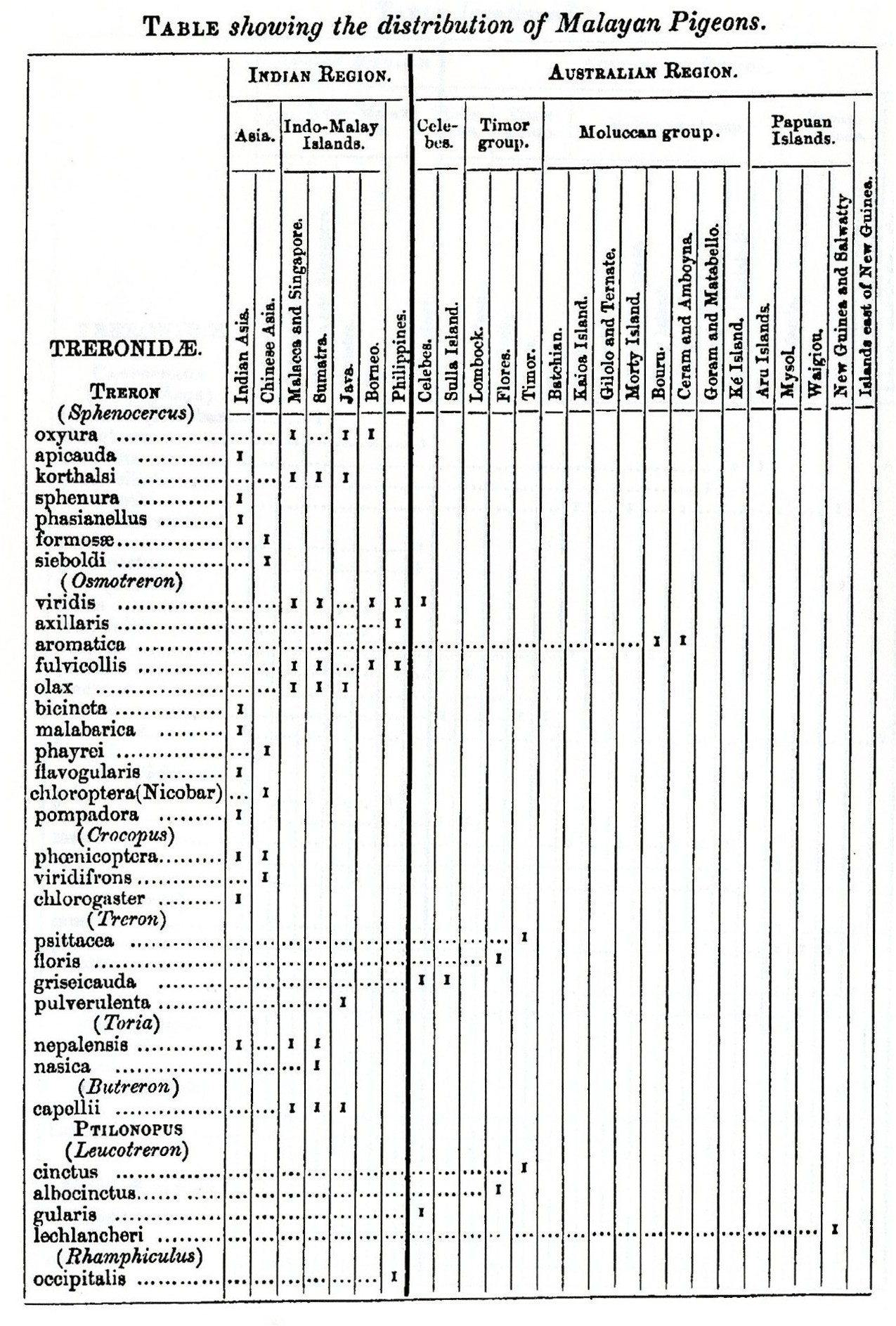
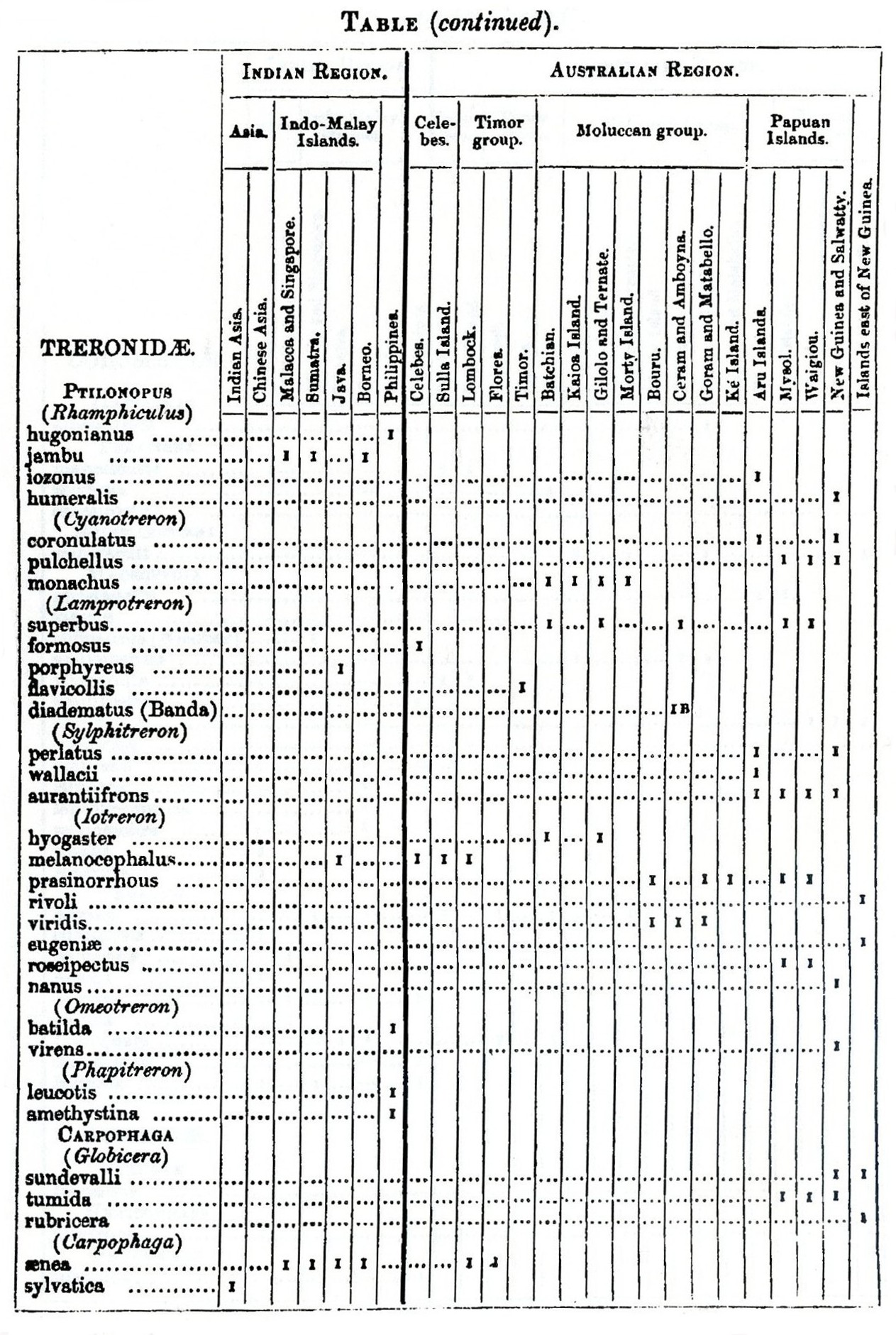
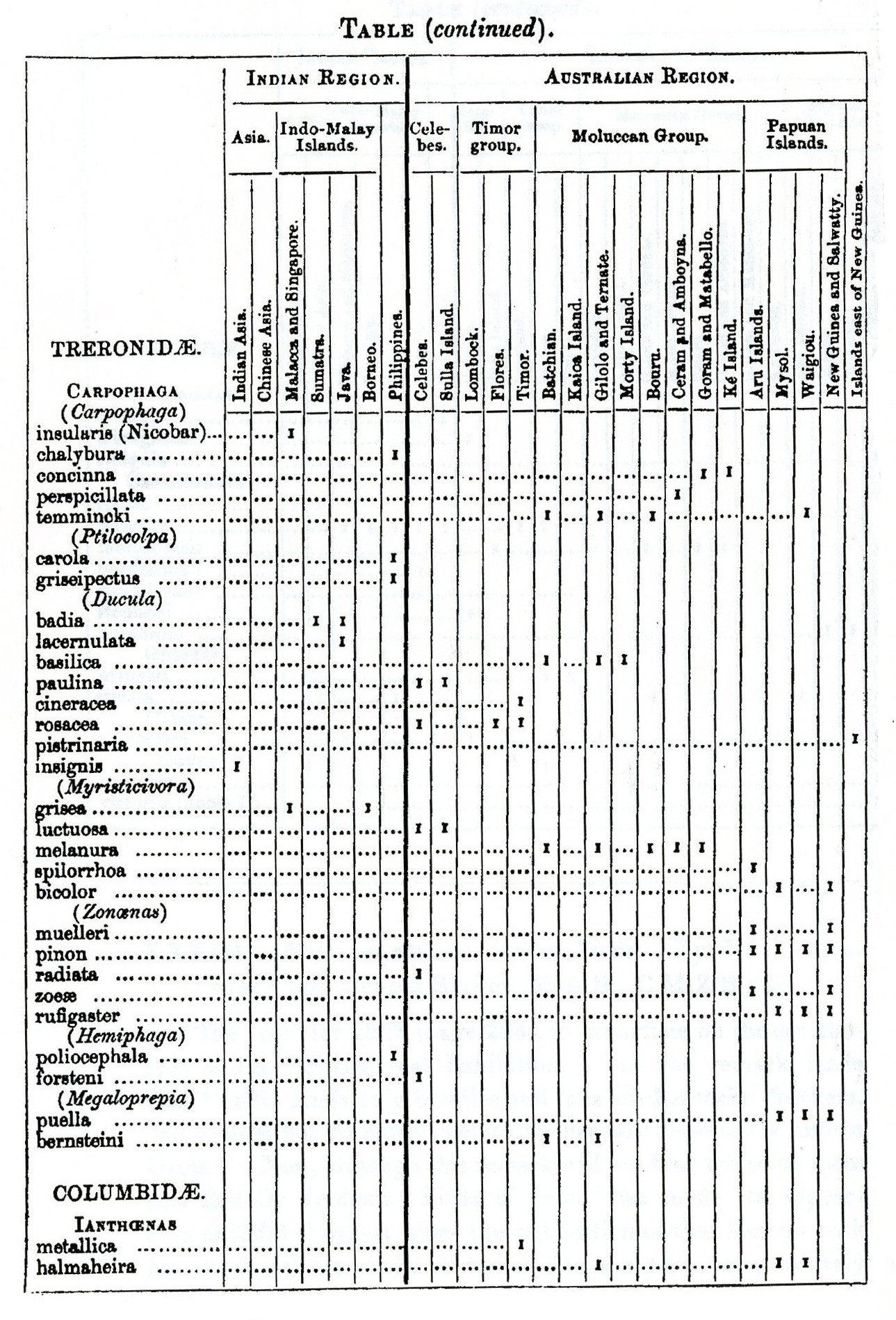
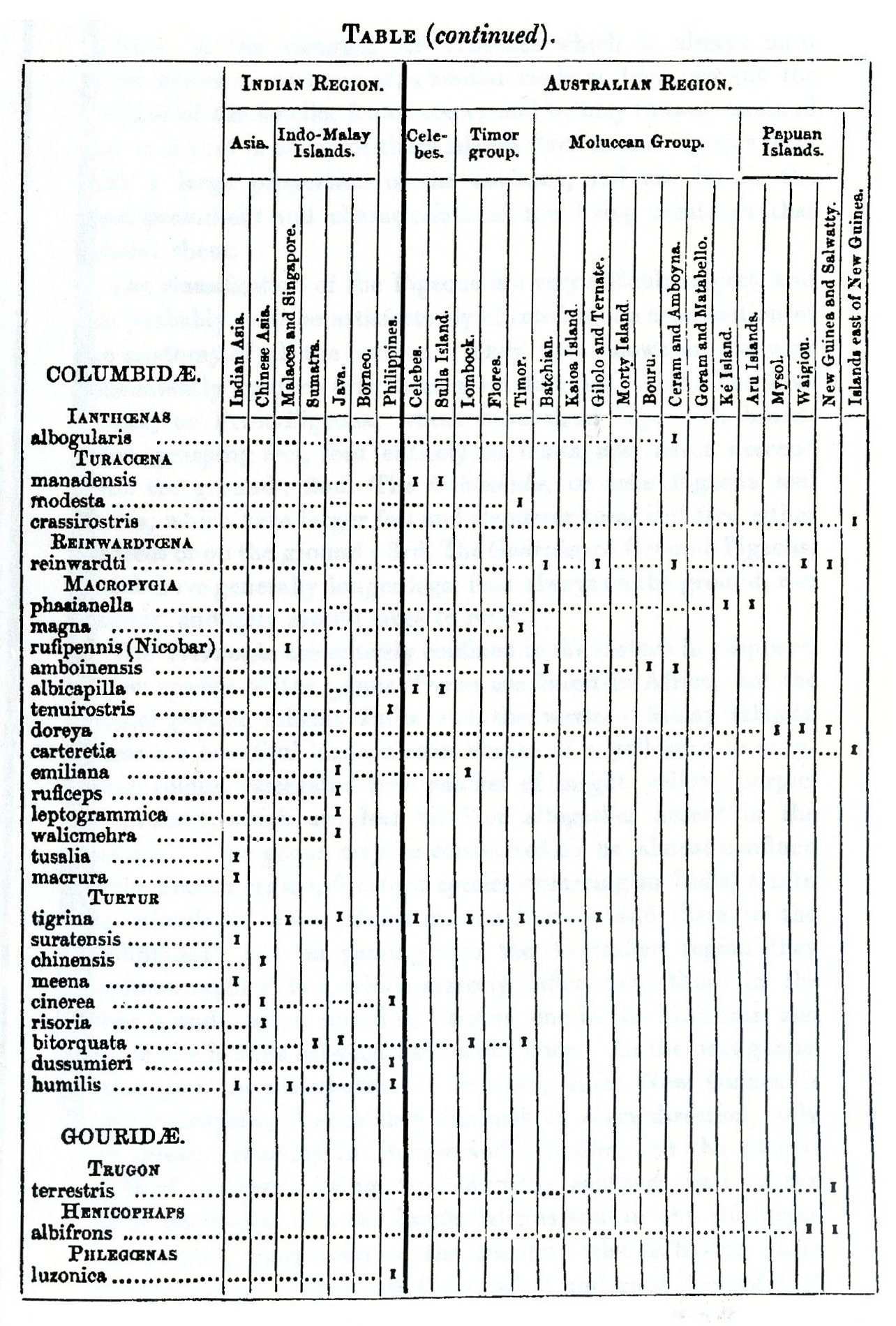
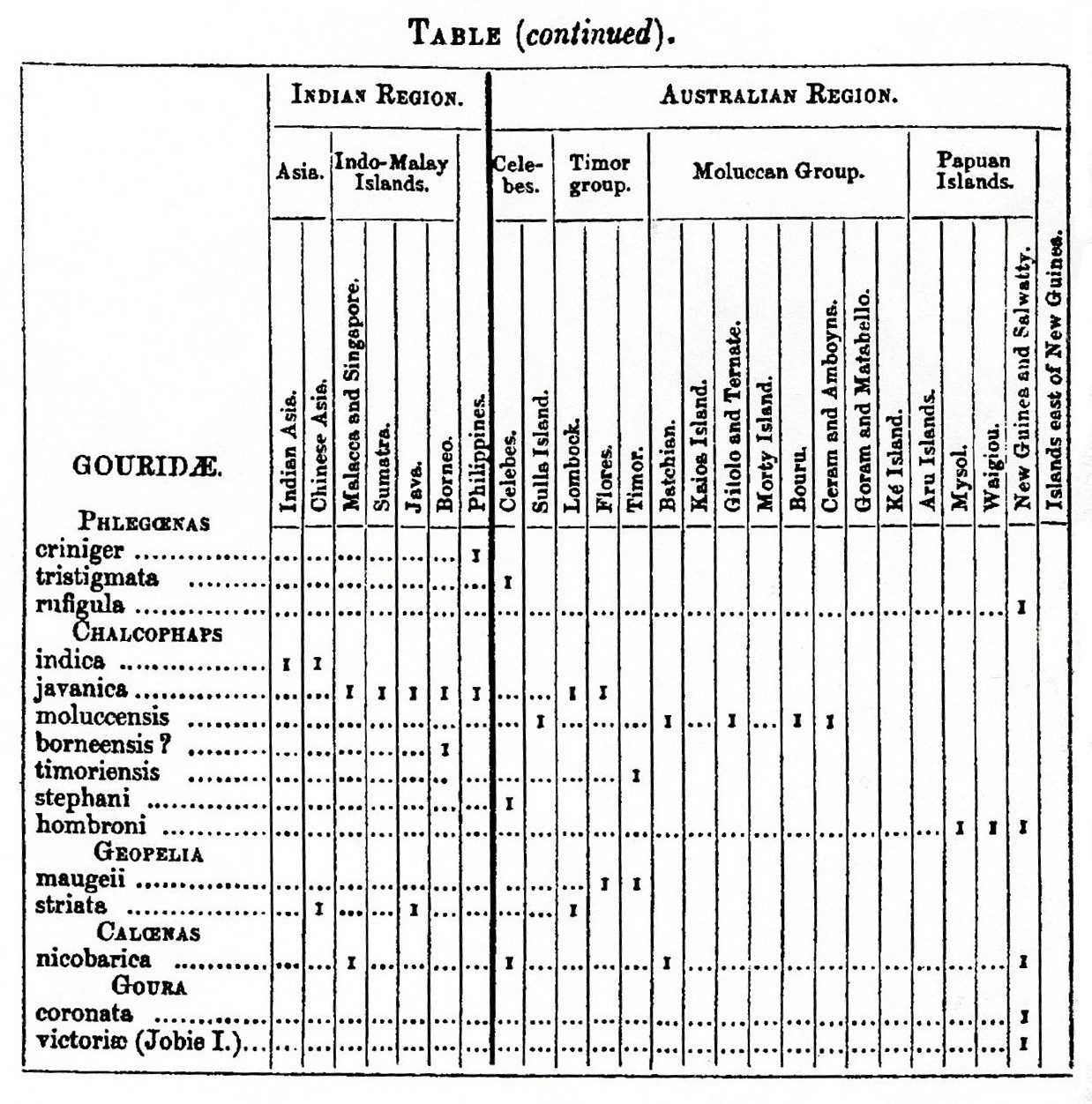
The classification of the Pigeons is a very difficult subject, and can probably only be satisfactorily effected by an examination of the anatomy of all the genera. They may, however, be very conveniently grouped into three great families:--1st. The Treronidæ, or Fruit-Pigeons, which have short legs with broad-soled, grasping feet, feed entirely on fruits, and never descend upon the ground; 2nd. The Columbidæ, or true Pigeons and Doves, which have larger feet and slenderer toes, and feed either on trees or on the ground; 3rd. The Gouridæ, or Ground-Pigeons, which have generally longer legs, feed always on the ground, run quickly, and only ascend trees to roost. The Treronidæ are entirely confined to the eastern hemisphere. A few species of the genus Treron are found in Africa, but the greater portion inhabit India and the western Malay Islands. These are beautiful birds, almost always of a yellowish or ashy-green colour, variegated with patches of bright yellow, purple, or chestnut, which are less vivid or altogether absent in the females. This genus may be considered to be almost confined to the Indian region, fourteen species occurring in India, ten in the islands of Java, Sumatra, and Borneo, and three in the Philippines; but on passing into the Australian region they diminish rapidly, two, which scarcely differ from those in the other islands, being found in Celebes, one in the Moluccas; and two in the islands between Java and Timor. In the next genus, Ptilonopus, the distribution is reversed, since New Guinea is their metropolis, whence they diminish in every direction, only one species occurring in Borneo and Sumatra, and the utmost limits of the genus being reached in the southern part of the Malay peninsula. In the Pacific islands and in the Moluccas they abound, many even of the smallest islands having their peculiar species. These are the smallest and most beautiful of [[p. 368]] the Fruit-Pigeons; their ground-colour is generally of a rich grass-green, diversified with bands and spots, caps, and shoulder-patches of the most vivid colours--crimson, pink, purple, white, or yellow in endless diversity. The genus Carpophaga, on the other hand, comprises the giants of the family. They also have their metropolis in New Guinea, but they extend further westward, two species occurring in India. Some of these birds have a deep booming note, which might almost be taken for the roar of a wild beast. Their gape and throat are so extensile that they can swallow very large fruits. In the Moluccas they devour the nutmegs, as soon as the fruits open, for the sake of the mace, which is digested off in the bird's stomach, and the seed disgorged entire. Looking at the whole family of Fruit-Pigeons, we find that fifty-four species are confined to the Austro-Malayan subregion, while twenty-eight inhabit the Indo-Malayan district, only three species (one of each genus) being common to the two. Beyond the Archipelago, fourteen species (all of the genus Treron) are found in India, and six of the same genus in Africa; thirty (of the genera Carpophaga and Ptilonopus) inhabit the various islands of the Pacific, and eight have been found in Australia and New Zealand. Even with our present imperfect knowledge of New Guinea we have fourteen species from that island, a larger number than are known to inhabit any other single tract of land, and plainly marking it out as the focus of the group. Of all the other islands Celebes is by far the richest in Fruit-Pigeons, containing ten species, seven of which are peculiar to it. The family Columbidæ is chiefly represented in the Archipelago by the genus Macropygia, which extends from the Himalayan Mountains to Australia and the Pacific Islands. Rarely is more than a single species found in any island, except in Java, which has three if not four species, and may therefore be considered the headquarters of the genus. These birds feed on the ground or on low bushes; and all are more or less of a chestnut-brown colour, and have long and graduated tails. They are of a weak structure and seldom take long flights. Turacœna and Reinwardtœna are two genera so closely allied to Macropygia that they have been often combined with it. The former, [[p. 369]] however, is characterized by the shorter tail, the bare orbits, and the black colour of the plumage. Three species only are known, which are widely scattered over the Austro-Malayan subregion, though each species is very local--one being confined to Celebes, another to Timor, and the third to the Solomon Islands. In the Moluccas, which occupy the space between the widely scattered localities of Turacœna, is found the single species of Reinwardtœna, which has a much stronger bill and longer tail, and has the whole under surface white, while the back is rich brown. The presence of these birds, so closely allied to Macropygia, in the Austro-Malayan subregion only, would lead us to suppose that this peculiar form of Pigeon is really most characteristic of that district, and that the preponderance of the species of Macropygia in Java is only due to some favourable local conditions. The beautiful metallic Pigeons forming the genus Ianthænas, and which seem to form a transition from the Macropygiine form to that of the true Pigeons, are found also in the Moluccas, New Guinea, and Timor, extending to the Pacific islands, and one species to Japan. The old-world genus Turtur has a few representative species in the Indo-Malay islands, but does not properly extend to the Australian region, as only stragglers have reached Timor along the chain of islands from Java, and those found in the Moluccas may perhaps have been introduced, as they have not extended to the easternmost islands or to New Guinea. The Gouridæ, or Ground-Pigeons, seem especially to abound in the Australian and American regions. Of the seven genera found in the Archipelago only two extend on to the continent of Asia (one species of each), while five are confined to the Austro-Malayan subregion and three to New Guinea, and several other peculiar genera inhabit Australia and the Pacific islands. Of the seventeen or eighteen species in the Archipelago no less than fourteen inhabit the Austro-Malayan subregion, and seven are found in New Guinea itself, although so little is yet known of that great island. Some of these are among the most remarkable of Pigeons. Trugon terrestris, by its stout hooked bill and strong legs, shows some approach to the wonderful Didunculus, the existing representative of the Dodo. [[p. 370]] Henicophaps has a long, straight, and powerful bill, like that of some of the larger Plovers. Calœnas nicobarica I believe to have spread westwards from New Guinea as far as the island where it was first found and from which it has derived its name. It has a massive body, with immense pectoral muscles, and very stiff and ample wings, and is thus capable of passing from island to island; and it is a remarkable fact that it is found almost entirely on small uninhabited islands, scattered at intervals over the four thousand miles of ocean between New Ireland and the Nicobar Islands. Over this wide range it presents no perceptible differences of form or colouring, which may be considered to indicate that migration still takes place at intervals, and by crossing the breeds in distinct islands, checks the formation of local races. Phlegœnas is another beautiful genus, scattered sparingly over a wide area; but here each island has a distinct species, showing that the causes that once favoured the distribution of the form have now ceased to act. Accordingly we find these birds to have a much weaker structure than Calœnas, and limited powers of flight. The magnificent Crown-Pigeons, the largest and most majestic of the whole order, are confined to the Papuan islands, where they take the place of the Curassows of South America. I have often seen these fine birds walking along the forest-paths in New Guinea, where the absence of carnivorous mammals, and the scarcity of large reptiles and of birds of prey, permit them to multiply unmolested. When disturbed, they fly up into the lowest branches of the nearest tree, in which situations they roost; but they spend the greater part of the day upon the ground, feeding on fallen fruits. The Geopeliæ are small, long-tailed Ground-Doves closely resembling Turtledoves in appearance, but having their nearest allies in several Australian species. They appear to have passed from Australia into Timor, and thence along the chain of islands into Java, as they are not found in any of the other parts of the archipelago. The green Ground-Doves of the genus Chalcophaps are the only ones which have a more extended distribution. All the species, however, are very closely allied; and the one which is found in India is so very similar to that of the western Malay islands, that [[p. 371]] its extension on to the continent may probably not have been of very ancient date. Indeed we have so many instances of the larger animals multiplying rapidly and becoming thoroughly acclimatized in countries very remote from their original home and often differing very widely from it in physical conditions, that I should be inclined to think that in this case, as in many others, the distribution of species has been modified by the agency of man. From a very remote date there must have been communication between Java and India, since the Hindoo religion had been established in the island for an unknown period when it was subverted by Mahommedanism in the fifteenth century; and it is highly probable that a bird so beautiful, and so easily caught and preserved, as the Chalcophaps javanica, should have been often carried to the continent, where a few escaping would soon stock a wide extent of country. The fact of this being the only Ground-Dove in all India, and that it so closely resembles the Javan bird that great doubts are entertained of its specific distinctness, renders the supposition of its recent introduction highly probable, since, in most other cases, the species of Java and those of India offer well-marked differences. If we now turn from the consideration of the separate families, genera, and species to the distribution of the Pigeons as a whole, we shall discover facts not less interesting. The total number of Pigeons now known to exist is about three hundred, or perhaps a few more; and of these the Malay Archipelago possesses no less than one hundred and eighteen. This number will seem especially large if we compare it with that representing the species of Pigeons in other countries. According to Jerdon's work on the Birds of India, only twenty-eight Pigeons are found in that country, exclusive of Ceylon and the countries east of the bay of Bengal. Australia possesses twenty-three species, Africa less than forty, while the vast continent of America has not more than eighty of these beautiful birds. These numbers show that the Malay Archipelago is preeminently the metropolis of the Pigeon tribe. It is now well known, however, that this part of the world belongs to two distinct zoological regions--the Indian and the [[p. 372]] Australian: and in these the Pigeons are very unequally distributed; for the western and larger portion (the Indo-Malayan subregion) contains nine genera and forty-three species, while the eastern and smaller portion (the Austro-Malayan subregion) has fifteen genera and eighty-four species. Here, therefore, the species of Pigeons become more condensed and more varied than in any other part of the globe: here is the focus of the order; and it was probably from this part of the world that the original dispersal and modification of the group chiefly took place. This condensation is carried to its greatest height in New Guinea, in which, although only a few points on its coast have been visited, no less than twenty-five species of Pigeons have been obtained. I believe, therefore, that the distribution of Pigeons in the Malay Archipelago fully confirms the results I have already arrived at from the study of other groups of birds, mammalia, and insects. These are, briefly, that this district is not one of the primary divisions of the globe, but that while one-half of it belongs to the Indian region, the other forms part of that of Australia; that the whole district may be further divided into groups of islands, the productions of which have a very close affinity--the Moluccan group being a satellite of New Guinea, while the Timor group is more closely connected with Australia; that Celebes is a very isolated and remarkable island, which, from the variety and peculiarity of its productions, appears to be the remnant of some more extensive land, which existed anterior to the present distribution of land and water in the surrounding regions; and that New Guinea must be looked upon as the remnant of a vast continent, now sunk beneath the waves of the Pacific. We find, also, that among the Indo-Malay islands (Sumatra, Java, and Borneo) Java is far the most isolated, possessing a considerable number of species peculiar to itself, while almost all those of Sumatra and Borneo are common to those two islands. We learn from this that what at first sight seems a very probable tradition of the Javans, the very recent separation of their island from Sumatra, is the reverse of truth since the evidence of the distribution of the Pittidæ, of the Parrots, and of the Pigeons among birds, of the Squirrels [[p. 373]] among mammals, and the Papilionidæ among insects, distinctly proves that, while all these islands have at no very remote geological epoch been united to the continent, yet the separation of Java was the earliest event, long subsequent to which a land communication existed between Sumatra and Borneo, although a far wider sea now separates them than the narrow strait which divides Sumatra from Java. In the following list of the Malayan species of Pigeons, which I have endeavoured to make as complete as possible, I have thought it necessary to refer, in most cases, only to Bonaparte's 'Conspectus,' where a full synonymy is given, and to a good figure. Wherever practicable, I have given the colour of the eyes, bill, and feet from my own notes, as well as the dimensions, taken in the flesh and thus indicating the true size of the bird. For the localities I have chiefly depended on my own observations, indicated by "(Wall.)" after the names of places where I myself observed the species; but I have also given such other localities as appeared to me trustworthy, with an indication of the authority. I have added a list of such Indian and Chinese species as belong to genera occurring in the Malay islands. Descriptions of four species, which seem to me to require separation, have been given, and a few notes on habits and synonymy are occasionally inserted. The table of the distribution of the species has been found useful in the preceding generalizations, and will enable the ornithologist to see at a glance what species have as yet been ascertained to inhabit each island. I have adopted the limits of the Archipelago which are pointed out in my paper "On the Physical Geography of the Malay Archipelago," printed in the Journal of the Royal Geographical Society for 1863. Order COLUMBÆ. Family TRERONIDÆ. Fruit-Pigeons. TRERON, Vieill. (Sphenocercus, Gr.) 1. TRERON OXYURA, Reinwt.; Pl. Col. 240; Bp. Consp. ii. p. 8. Hab. Malacca, Java, Borneo (Bp.). 2. TRERON KORTHALSI, Bp. (Sphenura, Temm.), Consp. Gen. Av. ii. p. 9. Hab. Malacca, Sumatra (Bp.), Java (Wall.). (Osmotreron, Bp.) 3. TRERON VIRIDIS. Scop. (Briss. i. p. 143, C. viridis philippensis.) T. vernans, Gm.; Bp. Consp. ii. p. 12. Hab. Philippine Islands (B. M.); Penang (Wall.), head darker; Sumatra (Wall.); Borneo (Wall.), head paler; Macassar (Wall.), front and throat greenish. 4. TRERON AXILLARIS, Bp. (ex Gray), Consp. Gen. Av. ii. p. 13. Columba aromatica,
Gm.; Bp. Icon. Pig. pl. 6. 5. TRERON AROMATICA (Gm.). "Columba viridis Amboinensis," Briss. Hab. Bouru, Amboyna (Wall.). See Proc. Zool. Soc. 1863, p. 33. [[p. 375]] 6. TRERON FULVICOLLIS (Wagl.), (cinnamomea, Temm.) Knip, Pig. 1, t. 6; Bp. Consp. ii. p. 14 (tenuirostre, Eyton). Hab. Borneo, Malacca (B. M.), Philippine Islands (Bp.), Borneo (Motley), Sumatra (Wall.). 7. TRERON OLAX, Temm. Pl. Col. 241, ; Bp. Consp. ii. p. 15. Hab. Java (Bp.); Sumatra, Malacca (Wall.). (Treron, Vieill.) 8. TRERON PSITTACEA, Temm. Pig. t. 4; Bp. Consp. ii. p. 10. Hab. Timor (Wall.). 9. TRERON FLORIS, Wall. Proc. Zool. Soc. 1863, p. 496. Hab. Flores and Solor Islands (Wall.). 10. TRERON GRISEICAUDA (Wall. ex G. R. Gray), Proc. Zool. Soc. 1862, p. 344. C. curvirostra, Vieill.; Bp. Icon. Pig. pl. 6. Hab. Sulla Island and Celebes (Wall.). 11. TRERON PULVERULENTA, Wall. 'Ibis,' 1863, p. 319. Hab. Java (Wall.). (Toria, Hodgs.) 12. TRERON NEPALENSIS, Hodgs.; Bp. Consp. ii. p. 11. Hab. Sumatra (Wall.), Nepal, Assam, Tenasserim, Malay Peninsula. 13. TRERON NASICA, Schleg. Ned. Tijdschrift, 1863, p. 67. Hab. Sumatra (Wall.). (Butreron, Bp.) 14. TRERON CAPELLII, Temm. Pl. Col. 143; Bp. Consp. ii. p. 9. Hab. Malay Peninsula, Sumatra (Wall.); Java (Bp.). PTILONOPUS, Sw. A. First primary abruptly attenuated at the end. 15. PTILONOPUS CINCTUS, Temm.; Knip, Pig. i. t. 23; Bp. Consp. ii. p. 15. Hab. Timor (Wall.). 16. PTILONOPUS ALBOCINCTUS, Wall. Proc. Zool. Soc. 1863, p. 496, pl. 39. Hab. Flores (Wall.). 17. PTILONOPUS GULARIS, Quoy & Gaim. Voy. Astr. t. 29; Bp. Consp. ii. p. 15. Hab. Menado (North Celebes) (Wall.). 18. PTILONOPUS LECHLANCHERI, Bp. (Trerolæma lechlancheri, Bp. Icon. Pig. pl. 16. (Carpophaga, pt., Gr.) Hab. New Guinea. [[p. 378]] b. Size moderate; tail shorter; tail-feathers 14. 19. PTILONOPUS OCCIPITALIS, Gray, Genera of Birds, ii. p. 467, t. 118. Hab. Philippine Islands. 20. PTILONOPUS HUGONIANUS, Schlegel, Ned. Tijdsch. v. d. Dierkunde, 1863, p. 60. Hab. Philippine Islands. 21. PTILONOPUS JAMBU, Gm.; Knip, Pig. i. t. 27; Bp. Consp. ii. p. 17. Hab. Malacca (Wall.), Borneo (Motley), Sumatra (Bp.). ** Tail square. 22. PTILONOPUS IOZONUS, G. R. Gray, Proc. Zool. Soc. 1858, p. 186. Hab. Aru Islands (Wall.). 23. PTILONOPUS HUMERALIS, Wall. Proc. Zool. Soc. 1862, p. 166, pl. 31. Hab. Salwatty and New Guinea (Wall.). *** Size small; bill small; tail somewhat rounded. (Cyanotreron, Bp.) 24. PTILONOPUS CORONULATUS, G. R. Gray, Proc. Zool. Soc. 1858, p. 185, pl. 138. Hab. Aru Islands, New Guinea (Wall.). 25. PTILONOPUS PULCHELLUS, Temm. Pl. Col. 564; Bp. Consp. ii. p. 22. Hab. Waigiou, Mysol, New Guinea (Wall.). 26. PTILONOPUS MONACHUS, Reinwt.; Pl. Col. 253; Bp. Consp. ii. p. 24. [[p. 379]] Hab. Batchian, Kaioa Island, Ternate, Gilolo, Morty Island (Wall.). c. Breast-plumes bifid or decomposed. (Lamprotreron, Ptilopus, Bp.) 27. PTILONOPUS SUPERBUS, Temm.; Knip, Pig. i. t. 33; Bp. Consp. ii. p. 18. Hab. Amboyna, Ceram, Batchian, Gilolo, Waigiou, Mysol, Aru Islands, New Guinea (Wall.). 28. PTILONOPUS FORMOSUS, G. R. Gray. Similis P. superbo (Temm.), sed fascia pectorali purpureo-nigro latiore et antice dilute purpurea, spatio postoculari viridi minus dilatato, rostro paullo minore. Rich green; forehead and crown purple pink; nape and sides of the neck, to the shoulders, rufous orange; a narrow space behind the eyes and the ear-coverts green; chin and throat ashy white; the forked feathers of the neck and breast purplish at the base, which becomes pure pale purple on the upper part of the breast, and shades into the deep purple-black band which crosses the middle of the breast; middle of belly and vent yellowish white; flanks green, crossed by a white band above the thighs; under tail-coverts white, yellow-tinged, and with green stripes and spots; a large patch on the shoulders and a spot on each of the scapulars, tertiaries, and adjacent wing-coverts deep purple; tail blackish, the feathers edged with green and purple, and a whitish band at the tip; primaries black, white-edged; secondaries and greater coverts green-margined and yellow-edged. Iris yellow; bill olive-horny; feet pinky-red. Female. Rather deeper coloured than the same sex in P. superbus. Total length 10 1/2 in.; wing 5 in. Hab. Macassar and Menado (Celebes) (Wall.). 29. PTILONOPUS PORPHYREUS, Reinwt. Pl. Col. 106; Bp. Consp. ii. p. 18. (P. roseicollis, Wagl.) Hab. Java (Wall.), "6000 to 8000 feet elevation." 30. PTILONOPUS FLAVICOLLIS, G. R. Gray; Bp. Consp. ii. p. 20; Icon. Pig. pl. 20. Hab. Timor (Wall.). 31. PTILONOPUS DIADEMATUS, Temm. Pl. Col. 254; Bp. Consp. ii. p. 17. Hab. Banda (Wall.). B. First primary but slightly and gradually narrowed at the end. (Sylphitreron, Verreaux.) 32. PTILONOPUS PERLATUS, Temm. Pl. Col. 559; Bp. Consp. ii. p. 40. Hab. Aru Islands (Wall.), New Guinea (Temm.). 33. PTILONOPUS WALLACII, G. R. Gray, Proc. Zool. Soc. 1858, p. 185, pl. 136. Hab. Aru Islands (Wall.). 34. PTILONOPUS AURANTIIFRONS, G.R. Gray, Proc. Zool. Soc. 1858, p. 185, pl. 137. Hab. Aru Islands, Mysol, Salwatty, New Guinea (Wall.). [[ p. 381]] (Iotreron, Bp.) 35. PTILONOPUS HYOGASTER, Reinwt.; Pl. Col. 252; Bp. Consp. ii. p. 25. Hab. Batchian, Gilolo (Wall.). 36. PTILONOPUS MELANOCEPHALUS, Gm.; Knip, Pig. i. t. 30; Bp. Consp. ii. p. 24. Hab. Java, Lombock, Celebes, Sulla Island (Wall.). 37. PTILINOPUS PRASINORRHOUS, G. R. Gray, Proc. Zool. Soc. 1858, p. 185. Hab. Bouru, Goram, Matabello, Ké Island, Mysol, Waigiou (Wall.). 38. PTILONOPUS RIVOLI, Prevost; Knip, Pig. ii. t. 57; Bp. Consp. p. 25. Hab. Louisiade Archipelago. 39. PTILONOPUS VIRIDIS, L.; Knip, Pig. ii. t. 17; Bp. Consp. ii. p. 24. Hab. Bouru, Amboyna, Ceram, Goram (Wall.). 40. PTILONOPUS EUGENIÆ, Gould, Proc. Zool. Soc. 1856, p. 137. Hab. Solomon Islands. 41. PTILONOPUS ROSEIPECTUS, G. R. Gray, Proc. Zool. Soc. 1861, p. 432. Hab. Waigiou, Gagy Island, Mysol (Wall.). 42. PTILONOPUS NANUS, Temm. Pl. Col. 565; Bp. Consp. ii. p. 25. Hab. New Guinea. [[p. 382]] (Omeotreron, Bp.) 43. PTILONOPUS BATILDA, Bp. Consp. Gen. Av. ii. p. 27. Hab. Philippine Islands. 44. PTILONOPUS VIRENS, Less. Voy. Coq. t. 42. f. 2; Bp. Consp. ii. p. 27. Hab. New Guinea. (Phapitreron, Bp.) 45. PTILONOPUS LEUCOTIS, Temm. Pl. Col. 189; Bp. Consp. ii. p. 28. Hab. Philippine Islands. 46. PTILONOPUS AMETHYSTINA, Bp. Consp. Gen. Av. ii. p. 28. Hab. Philippine Islands. CARPOPHAGA, Selby. (Globicera, Bp.) 47. CARPOPHAGA TUMIDA,Wall. (C.sundevalli, Bp., B.M. Cat. Columbæ, p. 18). C. pacifica, Gm.; Bp. Icon. Pig. pl. 35.; Consp. ii. p. 30. Æneo-viridis, aureo micans, alis caudaque purpureis; capite, collo, dorso superiore pectoreque pallide cinereis; nucha et corpore subtus vinaceo-canis; mento et fronte albis; tectricibus caudæ inferioribus castaneis, alis subtus cum tectricibus inferioribus fuscis; rostro parvo nigro-plumbeo, cera magna elevata tumida, pedibus et iridibus rubris. Brilliant metallic green, with golden and blue reflexions; wings and tail metallic purple; head, neck, breast, and upper part of back very pale ash-colour, except the back of the head and nape, which are tinged with red; breast and belly pale red or purplish buff; under tail-coverts rich chestnut-brown; under wing-coverts blackish ash; forehead and chin white; quills and tail beneath blackish. Bill and cere blackish lead-colour, the cere elevated and enormously swollen in a hump, like that of Anser cygnoides, in both sexes; eyelids pale; feet coral-red; iris crimson. Total length 17 in.; wing 9 3/4 in.; tail 6 1/4 in.; bill, from feathers at gape, 1 in. 48. CARPOPHAGA SUNDEVALLI, Bp. Consp. ii. p. 32; Icon. Pig. pl. 40. Hab. Caroline Island (Paris Mus.); Louisiade Archipelago (B. M.). 49. CARPOPHAGA RUBRICERA, Gr.; Bp. Consp. ii. p. 31. Hab. New Ireland (Paris Mus.). (Carpophaga, Selby.) 50. CARPOPHAGA ÆNEA (L.); Knip, Pig. i. t. 3; Bp. Consp. ii. t. 32. Hab. Java, Sumatra, Borneo, Lombock, Flores (Wall.), Malay Peninsula. 51. CARPOPHAGA CHALYBURA, Bp. Consp. ii. p. 32; Icon. Pig. pl. 43. Hab. Philippine Islands. 52. CARPOPHAGA CONCINNA, n. s. (C. chalybura, G. R. Gray, Proc. Zool. Soc. 1858, p. 186.) Cinereo-alba, capite cinerascente (fronte albo marginata), nucha cinereo-vinacea, dorso tectricibusque alarum viride purpureo [[p. 384]] et aureo micantibus, remigibus rectricibusque obscurioribus purpureis, tectricibus alarum inferioribus æneis et plumbeis, remigibus rectricibusque subtus nigrescentibus, tectricibus caudæ inferioribus castaneis. Pale ashy white; head pale ashy; forehead narrowly white, rufous-tinged; back, with upper
wing- and tail-coverts, rich metallic green with gold and purple reflections; quills and tail- Hab. Matabello Island, Sanguir Island, Aru (one small island west of) (Wall.); Banda Island,
Ké Island (seen, but no specimens obtained); Philippine Islands? (B. M.). 53. CARPOPHAGA PERSPICILLATA (Temm.), Pl. Col. 246; Bp. Consp. ii. p. 33. Hab. Ceram, Amboyna. 54. CARPOPHAGA TEMMINCKI, n. s. (C. perspicillata, Bp. Icon. Pig. pl. 45.) Similis C. perspicillatæ, sed dorso alisque magis cæruleis, capite colloque ardesiacis, pectore ardesiaco-cinereo, remigibus vix pulverulentis. Like C. perspicillata, Temm., but the back and wings more purplish green; the head and neck dark purplish ashy, shading into pure ashy on the breast, the metallic-green colouring extending up to the nape; the white circle round the eye, and the patch on the forehead, more distinct. [[p. 385]] Bill bluish horn, red at base above; feet dull purple; iris deep olive-brown. Total length 18 in. Hab. Bouru, Batchian, Gilolo, Waigiou (Wall.). (Ptilocolpa, Bp.) 55. CARPOPHAGA CAROLA, Bp. Consp. ii. p. 34. Hab. Philippine Islands. 56. CARPOPHAGA GRISEIPECTUS, Gray; Bp. Consp. ii. p. 34. Hab. Philippine Islands. (Ducula, Hodgs.) 57. CARPOPHAGA BADIA, Raffles; Temm. Pl. Col. 165; Bp. Consp. ii. p. 35. Hab. Java, Sumatra. 58. CARPOPHAGA LACERNULATA, Temm. Pl. Col. 194; Bp. Consp. ii. p. 35. Hab. Java (Wall.). 59. CARPOPHAGA BASILICA, Bp. Consp. ii. p. 35. Hab. Batchian, Gilolo, Morty Island (Wall.). 60. CARPOPHAGA PAULINA, Temm.; Knip, Pig. i. t. 4; Bp. Consp. ii. p. 35. Hab. Macassar, Menado (Celebes); Sulla Island (Wall.). 61. CARPOPHAGA CINERACEA, Temm. Pl. Col. 563; Bp. Consp. ii. p. 36. Hab. Timor (Wall.). [[p. 386]] 62. CARPOPHAGA ROSACEA, Temm. Pl. Col. 578; Bp. Consp. ii. p. 36. Hab. Flores, Timor, Macassar (Wall.). 63. CARPOPHAGA PISTRINARIA, Bp. Consp. ii. p. 36. Hab. Solomon Islands. (Myristicivora, Reich.) 64. CARPOPHAGA GRISEA, Bp. Consp. ii. p. 36. Hab. Malasia, Borneo. 65. CARPOPHAGA LUCTUOSA, Reinwt.; Pl. Col. 247. Hab. Menado, Macassar (Celebes); Sulla Island (Wall.). 66. CARPOPHAGA MELANURA, G. R. Gray, Proc. Zool. Soc. 1860, p. 361. Hab. Bouru, Ceram, Amboyna, Batchian, Gilolo, Goram (Wall.). 67. CARPOPHAGA SPILORRHOA, G. R. Gray, Proc. Zool. Soc. 1858, p. 186. Hab. Aru Islands (Wall.). 68. CARPOPHAGA BICOLOR, Scop.; Bp. Consp. ii. p. 36. Hab. Mysol, New Guinea (Wall.). [[p. 387]] (Zonæas, Reich.) 69. CARPOPHAGA MUELLERI, Temm. Pl. Col. 566; Bp. Consp. ii. p. 37. Hab. Aru Islands (Wall.), (New Guinea, Temm.). 70. CARPOPHAGA PINON, Quoy & Gaim. Voy. Uranie, t. 28; Bp. Consp. ii. p. 37. Hab. Aru Islands, New Guinea, Waigiou, Mysol (Wall.). 71. CARPOPHAGA RADIATA, Quoy & Gaim. Voy. Ast. t. 26; Bp. Consp. ii. p. 38. Hab. Macassar, Menado (Celebes) (Wall.). 72. CARPOPHAGA ZOEA, Less. Voy. Coq. t. 39; Bp. Consp. ii. p. 38. Hab. Aru Islands, New Guinea (Wall.). 73. CARPOPHAGA RUFIGASTER, Quoy & Gaim. Voy. Ast. t. 27; Bp. Consp. ii. p. 38. Hab. New Guinea, Mysol, Waigiou (Wall.). (Hemiphaga, Bp.) 74. CARPOPHAGA POLIOCEPHALA, Gray, Gen. of Birds, t. 119; Bp. Consp. ii. p. 39. Hab. Philippines. 75. CARPOPHAGA FORSTENI, Temm.; Knip, Pig. ii. p. 29; Bp. Consp. ii. p. 39. Hab. Celebes (Menado) (Wall.). [[p. 388]] (Megaloprepia, Reich.) 76. CARPOPHAGA PUELLA, Less.; Knip, Pig. ii. t. 1; Bp. Consp. ii. p. 40. Hab. New Guinea, Waigiou, Mysol (Wall.). 77. CARPOPHAGA BERNSTEINI, Schleg. Ptilopus bernsteini, Schleg. Nederl. Tijdsch. 1863, p. 59. Carpophaga formosa, G. R. Gray, Proc. Zool. Soc. 1860, p. 360. P. ochrogaster, Bernst. Ned. Tijdsch. 1865, p. 324. Hab. Gilolo (Wall.), Batchian (Bernstein). Family COLUMBIDÆ. Wood-Pigeons and Doves. IANTHŒNAS, Reich. 78. IANTHŒNAS METALLICA, Temm. Pl. Col. 565; Bp. Consp. ii. p. 44. Hab. Timor (Wall.). 79. IANTHŒNAS HALMAHEIRA, Bp. Consp. ii. p. 44. Hab. Gilolo, Waigiou, Mysol (Wall.). 80. IANTHŒNAS ALBOGULARIS, Bp. Comptes Rendus, xliii. p. 835. Hab. Ceram (Leyden Mus.). MACROPYGIA, Sw. 81. MACROPYGIA PHASIANELLA, Temm. Linn. Trans., xiii. p. 129; Gould, Birds of Australia, v. t. 75; Bp. Consp. ii. p. 56. Hab. Aru Islands, Ké Island (Wall.), Australia. 82. MACROPYGIA MAGNA, Wallace, Proc. Zool. Soc. 1863, p. 497. Hab. Timor (Wall.). 83. MACROPYGIA RUFIPENNIS, Blyth, J. A. S. Bengal, 1846, p. 371; Bp. Consp. ii. p. 56. Hab. Nicobar Islands. 84. MACROPYGIA AMBOINENSIS, L.; Bp. Consp. ii. p. 56. Hab. Bouru, Amboyna, Ceram (Wall.). Var. batchianensis (M. albicapilla, G. R. Gray, P. Z. S. 1860, p. 361), breast immaculate, violet brown; feathers of nape green-margined. Like M. ruficeps, but larger. Hab. Batchian (Wall.). Var. macassariensis, earthy brown markings, less distinct; resembles M. magna, but tail-markings agree with this species. Hab. Macassar (Wall.). 85. MACROPYGIA ALBICAPILLA, Bp. Consp. ii. p. 57. Hab. Macassar, Tondano (Celebes), Sulla Island (Wall.). 86. MACROPYGIA TENUIROSTRIS, Gray, B. M. Cat. Columb. p. 39; Pl. Col. 100 (phasianella). Hab. Philippines (B. M.). 87. MACROPYGIA DOREYA, Bp. Consp. ii. p. 57. Hab. New Guinea, Mysol, Waigiou (Wall.). 88. MACROPYGIA CARTERETIA, Bp. Consp. ii. p. 57. Hab. New Ireland. 89. MACROPYGIA EMILIANA, Bp. Consp. ii. p. 58. Hab. Java, Lombock (Wall.). 90. MACROPYGIA RUFICEPS, Temm. Pl. Col. 561; Bp. Consp. ii. p. 58. Hab. West Java (Wall.). 91. MACROPYGIA LEPTOGRAMMICA, Temm. Pl. Col. 560; Bp. Consp. ii. p. 58. (M. unchall, Wagl.) Hab. West Java (Wall.). 92. MACROPYGIA WALICMEHRA, Reich. Columbariæ, p. 86. Hab. Java. TURACŒNA, Bp. 93. TURACŒNA MANADENSIS, Quoy & Gaim. Voy. Astr. t. 30; Bp. Consp. ii. p. 58. Hab. Macassar, Menado (Celebes), Sulla Island (Wall.). 94. TURACŒNA MODESTA, Temm. Pl. Col. 552; Bp. Consp. ii. p. 59. Hab. Timor (Wall.). 95. TURACŒNA CRASSIROSTRIS, Gould, Proc. Zool. Soc. 1856, p. 136. Hab. Guadalcanar (Solomon Islands). REINWARDTŒNA, Bp. 96. REINWARDTŒNA REINWARDTI, Temm. Pl. Col. 248; Bp. Consp. ii. p. 59. Hab. Batchian, Gilolo, Amboyna, Ceram, Waigiou, New Guinea (Wall.). TURTUR, Selby. 97. TURTUR TIGRINA, Temm. Pig. t. 43. (Bp. Consp. ii. p. 65, T. chinensis.) Hab. Malay Peninsula, Java, Lombock, Celebes, Flores, Timor, Ternate (Wall.). (Streptopelia, Bp.) 98. TURTUR BITORQUATA, Temm.; Knip, Pig. i. t. 40; Bp. Consp. ii. p. 65. Hab. Java, Lombock, Flores, Timor (Wall.). [[p. 392]] 99. TURTUR DUSSUMIERI, Temm. Pl. Col. 188; Bp. Consp. ii. p. 65. Hab. Philippine Islands (B. M.), Java, Sumatra, Borneo (Bp.), ? err. loc. 100. TURTUR HUMILIS, Temm. Pl. Col. 259; Bp. Consp. ii. p. 66. Hab. Philippine Islands, var. (Bp.), Malacca (Wall.). 101. TURTUR CINEREA, Scop.; Bp. Consp. ii. p. 61. Hab. Philippine Islands. Family GOURIDÆ. Ground-Pigeons. TRUGON, Homb. & Jacq. 102. TRUGON TERRESTRIS, Homb. & Jacq. Voy. au Pôle Sud, Ois. t. 28. f. 1; Bp. Consp. p. 86. Hab. New Guinea (N.W. extremity) (Wall.). HENICOPHAPS, G. R. Gray. 103. HENICOPHAPS ALBIFRONS, G. R. Gray, Proc. Zool. Soc. 1861, p. 432, pl. 44. Hab. New Guinea, Waigiou (Wall.). PHLEGŒNAS, Reich. 104. PHLEGŒNAS LUZONICA, Scop. (cruenta, Gm.); Knip, Pig. i. t. 8; Bp. Consp. ii. p. 88. Hab. Philippine Islands. 105. PHLEGŒNAS CRINIGER, Homb. & Jacq. Voy. au Pôle Sud, t. 27. f. 2, ; Bp. Consp. ii. t. 88. P. bartletti, Sclat. Proc. Zool. Soc. 1863, p. 377, pl. 34. Hab. Sooloo Islands.
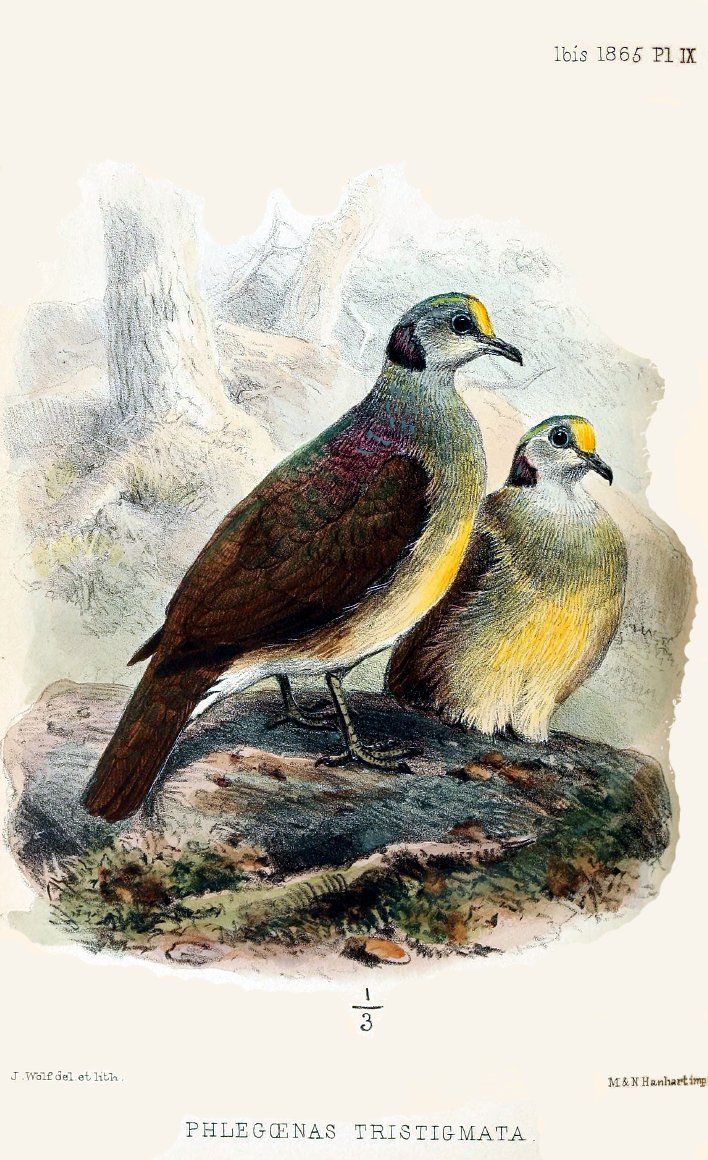
(Plate X.) [[actually, plate IX --Ed.]] Hab. Macassar, Menado (Celebes) (Wall.). 107. PHLEGŒNAS RUFIGULA, Puch. Voy. au Pôle Sud, t. 27. f. 1; Bp. Consp. ii. p. 88. Hab. New Guinea (Homb. & Jacq.). CHALCOPHAPS, Gould. 108. CHALCOPHAPS JAVANICA, Gm.; Bp. Consp. ii. t. 91. Hab. Borneo, Java, Lombock, Flores (Wall.), Sumatra (Mus. Leyden). 109. CHALCOPHAPS MOLUCCENSIS, G. R. Gray, Proc. Zool. Soc. 1860, p. 361, ; Wallace, Proc. Zool. Soc. 1862, p. 345. Hab. Bouru, Batchian, Ternate, Gilolo, Ceram, Amboyna, Sulla Island (Wall.). 110. CHALCOPHAPS BORNEENSIS, Bp. Comptes Rendus, xliii. p. 948. Hab. Borneo. 111. CHALCOPHAPS TIMORIENSIS, Bp. Comptes Rendus, xliii. p. 948. Hab. Timor (Wall.). [[p. 394]] 112. CHALCOPHAPS STEPHANI, Homb. & Jacq. Voy. au Pôle Sud, t. 38. f. 2. Hab. North Celebes (Wall.). 113. CHALCOPHAPS HOMBRONI, n. sp. (C. stephani, pt., Bp. Consp.) Similis C. stephani, sed minor; fronte cæruleo-grisea, collo et dorso rufis nec violaceis. Smaller than C. stephani; rufous, above dusky rufous; forehead slate-colour; the middle and larger wing-coverts and ends of the tertiaries golden green; back black, with two yellowish bands; bill red; feet purple-red; iris dark olive. Length 9 1/2 in.; wing 5 1/4 in. Hab. New Guinea, Waigiou, Mysol (Wall.). GEOPELIA, Sw. 114. GEOPELIA MAUGEII, Temm.; Knip, Pig. i. t. 52; Bp. Consp. ii. p. 94. Hab. Timor, Flores (Wall.). 115. GEOPELIA STRIATA, L.; Knip, Pig. i. t. 47: Bp. Consp. ii. t. 94. Hab. Lombock (Wall.), Java (B. M.), China (B. M.). CALŒNAS, Gray. 116. CALŒNAS NICOBARICA, L.; Knip, Pig. i. t. 2; Bp. Consp. ii. p. 95. Hab. Batchian, New Guinea (Wall.); widely distributed over the archipelago. GOURA, Flem. 117. GOURA CORONATA, L.; Knip, Pig. i. t. 1; Bp. Consp. ii. p. 96. Hab. Waigiou, Mysol, New Guinea (Wall.). 118. GOURA VICTORIÆ, Fraser, Proc. Zool. Soc. 1844, p. 27; Gray & Mitchell, Gen. of Birds, ii. t. 120; Bp. Consp. ii.p. 96. Hab. Jobie Island (North of New Guinea).
|