The
world economy is in trouble, and governments are making things
worse.
Here's the story, right out of the pages of the 2012 Index of Economic Freedom,
published Thursday by the Heritage Foundation and The Wall Street
Journal:
"Rapid
expansion of government, more than any market factor, appears to be responsible
for flagging economic dynamism. Government spending has not only failed to
arrest the economic crisis, but also—in many countries—seems to be prolonging
it. The big-government approach has led to bloated public debt, turning an
economic slowdown into a fiscal crisis with economic stagnation fueling
long-term unemployment."
The
new index documents a world in which economic freedom is contracting, hammered
by excessive government regulations and stimulus spending that seems only to
line the pockets of the politically well-connected.
Government spending rose on average to 35.2% of gross domestic product (GDP)
from 33.5% last year as measured by the 2012 index.
Enlarge
Image
Most
of the decline in economic freedom was in countries in North America and Europe.
Canada, the United States and Mexico all lost ground in the index, and 31 of the
43 countries in Europe suffered contractions. They
ought to know better. These are the very countries that have led the world-wide
revolution in political and economic freedom since the end of World War II. But
now, weighed down by huge welfare programs and social spending that is out of
control, many governments are expanding their reach in ways more reminiscent of
the 1930s than the 1980s.
How
about the U.S., historically the country more responsible than any other for
leading the march of freedom? Under President Barack Obama, it has moved to the
back of the band. Its economic freedom score has dropped to 76.3 in 2012 from
81.2 in 2007 (on a scale of 0-100). Government expenditures have grown to a
level equivalent to over 40% of GDP, and total public debt exceeds the size of
the economy.
The
expansion of government has brought with it another critical challenge to economic
freedom: corruption. The U.S. score on the index's Freedom
from Corruption indicator has dropped to 71.0 in 2012 from 76.0 in
2007. That's not surprising, given the administration's
excessive regulatory zeal. Each new edict means a new government bureaucracy
that individuals and businesses must navigate. Each new law opens the door for
political graft and cronyism.
There
are some bright spots. Economic freedom has continued to increase in Asia and
Africa.
In fact, four
Asia-Pacific economies—Hong Kong, Singapore, Australia and New Zealand—top the
Index of Economic Freedom this year. Taiwan showed
impressive gains, moving into the index's top 20. Eleven of the 46 economies in
sub-Saharan Africa gained at least a full point on the index's economic freedom
scale, and
Mauritius
jumped
into the top 10 with the highest ranking—8th place—ever achieved by an African
country.
The
2012 index results confirm again the vital linkage between advancing
economic freedom and eradicating poverty. Countries that rank "mostly unfree" or
"repressed" in the index have levels of poverty intensity, as measured by the
United
Nations' new Multidimensional Poverty Index, that
are three times higher than those of countries with more economic
freedom.
Enlarge
Image
AFP/Getty
Images
Taiwan
showed impressive gains, moving into the Index's Top 20.
Countries
with higher levels of economic freedom have much higher levels of per capita GDP
on average. In Asia, for example, the five freest economies have per capita
incomes 12 times higher than in the five least free economies. Economic growth
rates are higher, too, in countries where economic freedom is advancing.
The average growth rate
for the most-improved countries in the index over the last decade was 3.7%, more
than a point-and-a-half higher than in countries where economic freedom showed
little or no gain.
Positive
measures of human development in areas such as health and education are highly
correlated with high levels of economic freedom, and economically free countries
do a much better job of protecting the environment than their more regulated
competitors. When you actually look at the performance data, it turns out that
the "progressive" outcomes so highly touted by those favoring big government
programs to address every societal ill are actually achieved more efficiently
and dependably by the marketplace and the invisible hand of free
economies.
Unfortunately,
most of the world's
people still live in countries where economic freedom is heavily constrained by
government control and bureaucracy. India and China, with about one-third of the
world's population, have economic freedom scores barely above 50 (a perfect
score would be 100). In a globalized world, both countries are
benefiting from the trade and investment liberalization that has taken place
elsewhere. But sustained long-term growth will depend on advances in economic
freedom within each of these giants so that broad-based market systems may
develop.
The
Index of Economic Freedom has recorded a step back over the last year for the
world as a whole. It was only a small step, with average scores declining less
than a point, but the consequences have been severe: slower growth, fiscal and
debt crises, and high unemployment. The biggest losers have been the economies
in North America and Europe, regions that have led the world in economic freedom
over the years.
The
2012 results show the torch of leadership in advancing freedom passing to other
regions. Whether this is a long-term trend remains to be seen, but it is clear
that if America and Europe do not soon regain trust in the principles of
economic freedom on which their historical successes have been built, their
people, and perhaps those of the world as a whole, are in for dark days
ahead.
Mr.
Feulner is president of the Heritage Foundation and co-editor of the 2012 Index
of Economic Freedom.
The
annual Heritage Foundation-Wall Street Journal Index of Economic Freedom is
released today. Is economic freedom on the cusp of a
renaissance in Asia?
At
first blush, no.
China, now
the largest economy in the region, is firmly on a backward economic-freedom
trajectory. Foreign companies report an increasingly hostile regulatory
environment, and reform in general seems stalled.
Japan, the
next-largest economy, remains mired in political deadlock, and
key liberalization measures such as postal privatization are dead.
India
is
as sclerotic as ever, Indonesia is in danger of retreating on banking reforms it
made post-1997 crisis. Even Hong Kong, again ranked at the top of the
index, is every day in greater danger of abandoning the economic freedoms that
made it prosperous, whether through a proposed competition law or through the
government's sheer inability to resist meddling in this industry or
that.
In
recent months India has
seen fierce debates over corruption and allowing inward investment by foreign
big-box retailers. These issues aroused widespread discussion,
although they haven't yet produced positive policy outcomes. In New Delhi's
defense, the government has quietly opened additional channels for foreign
capital to invest in Indian businesses via stock and bond markets, and this week
it eased rules for foreign single-brand retailers.
Enlarge
Image
Associated
Press
South
Korean President Lee Myung-bak signing bills to implement the country's free
trade deal with the U.S. in November.
South
Korea has
started a pro-freedom rethink of economic policy. Most
visible is Seoul's new enthusiasm for free trade, as seen in the major deals
with the U.S. and European Union that are set to open Korea to a previously
unheard-of degree.
President Lee Myung-bak also has attempted controversial pro-freedom
reforms of labor laws and a liberalization of the media
industry. While these efforts have been only partly successful,
both sparked renewed public debate.
Taiwan
holds
a presidential election Saturday that turns in part on trade and investment
openness to China;
the incumbent candidate, Ma Ying-jeou, touts improved cross-Strait economic
freedom as a key accomplishment of his administration. Indonesia is determinedly if sometimes
inconsistently pushing forward with the fight against business-stifling
corruption.
Then
there's Japan. It fares
poorly in this year's index, with a decline in both its score
and its ranking (to 22 from 20 last year), not least because the government's
fiscal position deteriorated further. But even here there are some tentative
green shoots.
Tokyo
lawmakers recently rebelled against Prime Minister Yoshihiko Noda's plan to
increase the consumption tax. Mr. Noda has elsewhere distinguished himself
through his willingness to push Japan into negotiations for a Trans-Pacific
Partnership trade deal that would mark the greatest opening of the economy since
the late 1940s. And amid the chaos of a post-tsunami nuclear crisis, some brave
souls suggested a major reform of electric utilities. Dare to
dream.
As the
mixed index scores show, these rustlings of economic freedom
in Asia have not always translated into quantifiable policy
outcomes. They must eventually do so to have any impact on
business. Still, each law starts out as
an idea. At
least the right ideas are starting to percolate in many corners of the
region.
More
interesting is the possible explanation. The basic concept of economic freedom
has been in bad odor in many parts of Asia for long spans. Singapore and Japan, despite their
relatively high scores on the index, have always been characterized by a high
degree of government intervention in the business world—and their seeming
success served as an inspiration for others. The echoes
still reverberate. Despite his reformist leanings, Mr. Lee in Korea fell back on
green-tech industrial policy as an element of his post-global-crisis stimulus
plan, to cite only one of many examples.
Yet
there is mounting
evidence that the old, state-led model isn't working out so well. Japan's two
decades of stagnation are the obvious example, and they may
now be causing sufficient desperation to pave the way for freer trade. Korea
fears a similar fate could befall it as the economy reaches First-World levels
and growth rates slow. Some Indians worry that phenomenal growth will slow
before it has really begun unless New Delhi starts another round of
reforms.
This
is good news for business, or anyway it will be if these freedom ideas start
taking root. Asia's
phenomenal growth tends to obscure the destructive tendency of Asian governments
to undermine their entrepreneurial citizens with stifling regulations, often in
the name of encouraging a handful of favored industries, such as export
manufacturing, at the expense of many others.
Greater
economic freedom means unshackling those entrepreneurs, who are necessary for
sustained growth in the future. Asia can't afford not to do
this.
Mr.
Sternberg is an editorial page writer at The Wall Street Journal
Asia.
Wed
Jan 11, 2012 6:32pm GMT
http://af.reuters.com/article/commoditiesNews/idAFL6E8CB55620120111?sp=true
LONDON Jan 11 (Reuters) - The Philippines and Peru will be
among emerging economies that become much more prominent in the next few
decades, helped by demographics and rising education standards, with the
Philippines set to leapfrog 27 places to become the 16th largest economy by
2050, HSBC predicts.
The bank expects China to
overtake the United States as the world's biggest economy by 2050, and says
strong growth rates in other developing countries will help drive the global
economy.
"Plenty of places in the
world look set to deliver very strong rates of growth. But they are not in the
developed world, which faces both structural and cyclical headwinds. They are in
the emerging world," the bank said in its report 'The World in
2050'.
It based its forecasts on
fundamentals such as current income per capita, rule of law, democracy,
education levels and demographic change.
HSBC projects the
Philippines economy is poised to grow by an average of 7 percent annually over
the next 40 years, while Peru should average annual growth of 5.5 percent over
the same period.
The sheer pace of
population growth in countries such as Nigeria and Pakistan means that these
economies will swell in size to be included among the 100 biggest economies even
if their incomes on a per-capita basis remain low.
HSBC said lower
scores for rule of law in Latin America constrained its per-capita inccome
projections for the region though it noted that Brazil was making headway in
this aspect.
"The losers are
the small population, ageing economies of Europe,"
added the bank, which says the demographics in much of Europe underscores
concerns about the debt problems faced by many of the continent's
governments.
'COPY AND PASTE'
If sufficiently open to modern technology, developing
countries could enjoy many years of robust GDP growth although they could
struggle for growth drivers once they have adapted to technological advances,
HSBC said.
"The initial years of
development could be described as 'copy and paste'
growth, as countries open
themselves up and adapt to the world's existing technologies. Once the 'copy and
paste' growth is complete ... many economies struggle and get stuck in what is
often known as the middle-income trap."
"But many of the
countries we are considering are still at such an extremely low level of
development that there are years of this 'copy and paste' growth ahead," it
added.
It was here that many of
the pessimism about China was misplaced, the bank
argued.
"One of the most commonly
cited reasons for concern about China is the high rate of investment as a
percentage of GDP ...(But) we believe the strong rate of investment is entirely
justified - providing China with much needed basic infrastructure," it
said.
The bank said high levels
of education in central and eastern Europe meant that the region could enjoy
strong income per capita growth in the coming years before weak demographics
eventually sap economic growth.
"While education rates
are similar (to the West), the average income per capita in the central and
eastern Europe block is just one fifth that of the developed world. For this
reason ... economies have great scope to catch up in income per capita," it
said.
"Some of the
smaller Eastern European countries - Romania, the Czech Republic and Serbia -
(should) all do extremely well, particularly in the coming decade, before
demographics prove to be more of a drag." (Reporting
by Sebastian Tong; Editing by Susan Fenton)
© Thomson Reuters 2012 All rights
reserved
The
aftershocks, it is clear, will be disrupting global growth for some time. Less
clear is how the turmoil will alter economic strategies in China, India, Brazil
and other fast-growing emerging markets.
Will
they shrug it off? Will it prompt them to turn away from markets in favor of
more muscular government control? Will they evolve a new strain of
capitalism—the Beijing Consensus, perhaps—that becomes a beacon for
others? Is there any well-defined alternative?
In
emerging markets, skepticism and schadenfreude abound. "The old paradigm in
which the smart guys from Europe and America harangue us, wag a finger and tell
us: 'This is what you've got wrong'—that's over," says Rajiv Kumar, an Oxford
University-trained economist who is secretary-general of the Federation of
Indian Chambers of Commerce and Industry.
The
global financial crisis exposed shortcomings of U.S.-style capitalism, the
inadequacies of what the British dubbed "light touch" financial regulation and
the system's tendency toward periodic excess. More recently, Europe's
sovereign-debt crisis highlighted the tension of a costly welfare state in the
absence of vigorous economic growth to finance it.
Enlarge
Image
Associated
Press
India's
economic growth skidded to 6.9 % in the July-September quarter, its lowest in
over two years, and is forecast to slow further amid delayed economic reforms
and a worsening global outlook.
Above, an Indian man works at a textile factory in Ahmedabad,
India.
The
U.S. model continues to struggle three years after regulators allowed Lehman
Brothers to fail.
Billions of idle cash sits in U.S. corporate coffers even as millions of workers
remain unemployed for more than a year. The housing market remains in the
doldrums. Political paralysis on fiscal policy undermines the U.S.'s economic
authority. All this and more have weakened the single best argument for the U.S.
economic model: It works.
A few
years back, when Henry Paulson was still U.S. Treasury secretary, Wang Qishan,
China's vice premier, needled him. "Hank, I used to listen to you. You were my
teacher," recalls Mr. Paulson, who visited China often when he was head of
Goldman Sachs Group. "Maybe now my teacher doesn't seem so wise given the
mistakes you made."
Today,
Mr. Paulson adds: "We've given China a flawed model."
The
European model doesn't offer much, either. In one
of the most telling moments of 2011, Klaus Regling, who heads the euro zone's
bailout kitty, was dispatched in search of money—not to Washington but to
Beijing. The mission didn't produce results. It did, however, provoke bursts of
condescension from some in China about the flaws in the European model.
Jin
Liqun, chairman of the supervisory board of China's sovereign-wealth fund, China
Investment Corp., derided Europe as a "worn-out welfare society" in an
interview with al-Jazeera TV in November.
For
the old-money economies, 2011 was downright humiliating. Here are three points
to ponder:
• Who
could have imagined during the worst of the 1990s Asian financial crisis that in
November 2011 the
president of the Federal Reserve Bank of New York, William
Dudley, would tell cadets at the U.S. Military Academy at
West Point: "We can learn from the example of emerging nations that took the
tough decisions necessary to emerge from past crises stronger, more competitive
and better positioned…."
•
Or that the sovereign
debt of the U.S., Italy, Spain, Portugal, Ireland and Japan would be downgraded
while debt of Angola, Brazil, Bulgaria, Colombia, the Czech Republic, Estonia
and Peru would be upgraded.
•
Or that the winning
bidder for the Portuguese government's stake in a big electric utility would be
China's Three Gorges Corp., which beat two Brazilian firms and just one—a German
company—from the entire developed world.
"The
labor laws induce sloth, indolence, rather than hardworking," he said.
"The
incentive system is totally out of whack. Why should…some [euro-zone] member's
people have to work to 65, even longer, whereas in some other countries they are
happily retiring at 55, languishing on the beach? This is unfair."
"The
welfare system is good for any society to…help those who happen to be
disadvantaged to enjoy a good life," he said. "But a welfare society should not
induce people not to work." So much for Europe's "social market."
Japan's
export-driven model, once the envy of nearly every other economy, has been
largely written off, the consequence of a decadelong battle to revive growth.
Coupled with the blow of the Fukushima Daiichi nuclear calamity, wrought by last
March's tsunami and earthquake, and Japan's reputation for competence and
efficiencies was shot.
But is
there a well-articulated alternative to rich-country market capitalism?
Not
yet, says Joseph Nye, a Harvard University political scientist
who has
chronicled the evolution of global centers of power. "It's not like the Cold War
when there was an alternative ideology—communism—or the '30s, when you had two
contenders, communism and fascism."
After
all, most emerging markets today are embracing global capitalism and its
institutions. Russia is
about to join the World Trade Organization, the club of free
traders. China is seeking a bigger, not smaller, role in the International
Monetary Fund, the closest thing the market economies have to a global central
bank.
Niall
Ferguson, the
New York University historian, argues that emerging markets are succeeding by
downloading the "killer apps" of Western civilization. Kenneth Rogoff, the Harvard
University economist, says, "For now, at least, the only serious alternatives to
today's dominant Anglo-American paradigm are other forms of
capitalism." And Robert Zoellick, president of the
World Bank, says China's receptivity to markets means that it's easier to build
a private toll road in Chongqing than in Pennsylvania.
"Everyone
who criticized the system during the bubble years has been vindicated. And the
truth is a lot of bad things happened," says Arminio Fraga, a U.S.-trained
economist, formerly Brazil's central banker and now head of a private-equity
firm. "But a lot of peoples' claims are false. There's a danger that the pendulum
may swing too far in the wrong direction," he said, referring to emerging-market
flirtations with a return to more government management of the
economy.
Still,
if emerging markets are to peel away from the U.S.-Europe-Japan road, this would
appear to be a key moment. Those pondering economic routes that emerging markets
might take divide roughly into three camps.
One
camp sees emerging markets going in a new direction, perhaps inspired by China's
remarkable growth spurt and its mix of government control and market forces.
In a
book newly translated from Chinese, "Demystifying the Chinese Economy,"
Justin Yifu Lin, now chief economist of the World Bank, recalls "widespread
skepticism in international academic circles" when China launched its late-1970s
reforms of offering protection to big state-owned enterprises in "old priority
sectors" while introducing private enterprises into "new labor-intensive
sectors." In his view of history, other developing countries heeded the
"Washington Consensus" to dismantle every possible restraint on
markets—and "ended up in economic collapse and long-term stagnation."
Mr.
Lin, while acknowledging fault lines in Chinese growth, argues that, in general,
"opportunities and challenges facing developed countries differ from those of
developing countries." China, India and other economies with huge labor supplies
should pursue economic strategies different from those pursued by others, an
argument for China's heavy emphasis on promoting investment over consumer
spending and relying on exports to provide jobs.
But as
cracks in the Chinese success story emerge—scattered uprisings, tales of
spectacular corruption, high-speed rail crashes—some of its luster has been
lost. And Francois
Godement, a French specialist in Asia, describes China as split between
competing versions of its own model: the more Western-style move up the
technological value chain, which he calls the Guangdong model after the
prosperous coastal region, and the Chongqing experiment in the center of
China, which is marked by heavy state subsidies and paeans to Chairman Mao.
A
second camp argues
that emerging markets will prosper not by rejecting Western capitalism, but
executing it better,
perhaps finding a way to restrain its tendency toward financial excess while
retaining the efficiency of markets.
"Latin America has tried many models,"
says Liliana Rojas-Suarez, a Peru-born economist now at the Center for Global
Development, a Washington think tank. "This model"—markets, private
enterprise, orthodox macroeconomic policies—"is working for them."
Ms.
Rojas-Suarez points to Peru's new center-left president, Ollanta Humala, as
support for the second model. She notes that, despite some of his campaign
rhetoric, Mr. Humala hasn't deviated much from the previous government's course.
After all, Peru's economy grew a robust 8.8% in 2010 and 2011 growth is
forecast at 6.7%. "The
cost for a leftist government to change what is seen, so far, as a success is
just too large," she says.
Ernesto
Zedillo, the former president of Mexico, now teaching at Yale
University,
contends that Europe has failed to see what Mexicans understand about responding
to a financial crisis. "Latin America, after so many years, has learned its
lessons," he says. "In
the '80s, when we behaved just like the Europeans today, we were always behind
the curve." In the 1990s, he says, that wasn't so.
The
conclusion he drew, and repeated ever since: Markets overreact, so government
policy must overreact even more. Rich countries haven't heeded that lesson, he
says, bemoaning "the slowness, the parsimony, the hesitation, the political
conflict we have seen in Europe and in the U.S."
A
third camp sees what
the World Bank's Mr. Zoellick calls "ruthless pragmatism," an almost
ideology-free quest for results that will borrow freely from around the
world.
In
this vein, Olivier Blanchard, a France-born Massachusetts Institute of
Technology professor and now chief economist at the IMF, says: "If I were a
young, emerging-market country, my motto would be: Go slow."
He
advises them to develop a modern financial system slowly, adopting innovations
only as they are proven elsewhere and lowering barriers to foreign capital only
gradually. And he would
craft rules for labor markets with care to avoid the sclerosis plaguing some
richer economies. "Institutions have a life of their own," he
says.
From
his travels around the globe, Mr. Zoellick concludes: "People are looking for what works. It
was very important that you had a model that started to work in Japan, Korea,
Taiwan and then spread to others in Southeast Asia and China."
Have
emerging markets concluded that the U.S. and European models don't work? "Not
yet, but they could," he says. It depends whether the U.S., Europe and Japan
sort out their problems in the next several years.
Write
to David
Wessel at capital@wsj.com
Presenting
an annual investment outlook is a hazardous task. At the start of 2011, investors were
warned to eschew the bond market. Pundits described the low yields of U.S.
Treasuries as a "bond market bubble." In fact, if you had bought 30-year U.S.
Treasury bonds at the start of the year when they yielded 4.42% and held them
through 2011, when the yield had fallen to 2.89%, you would have earned a 34%
return.
Meanwhile,
U.S. stocks stayed flat, Europe and Japan declined by double digits, and
emerging markets suffered even greater losses. Last year again demonstrated that
it is virtually impossible to make accurate short-term predictions of asset
returns.
But it
is possible to make reasonable long-term forecasts. Let's start with the bond market. If
an investor buys a 10-year U.S. Treasury bond and holds it to maturity, he will
make exactly 2%, the current yield to maturity. Even if the inflation rate is
only 2%, the informal target of the Federal Reserve, investors will have earned
a zero rate of return after inflation.
With a
higher inflation rate, U.S. Treasurys will be a sure loser.
Other high-quality U.S. bonds will fare little better. The yield on a total U.S.
bond market exchange-traded fund (ticker BND) is only 3%. Bonds, where long-run
returns are easy to forecast, are unattractive in the U.S. and Japan, as well as
in Europe, where defaults and debt restructurings are
likely.
Long-run
equity return forecasts are more difficult, but they can be estimated under
certain assumptions. If
valuation metrics (such as price-earnings ratios) are constant, long-run equity
returns can be estimated by adding the anticipated 2012 dividend yield for the
stock market to the long-run growth rate of earnings and dividends. The dividend
yield of the U.S. market is about 2%. Over the long run, earnings and dividends
have grown at 5% per year.
Thus,
with no change in valuation, U.S. stocks should produce returns of about 7%,
five points higher than the yield on safe bonds.
Moreover, price-earnings multiples in the low double digits, based on my
estimate of the earning power of U.S. corporations, are unusually attractive
today.
Stocks
were losers to bonds in 2011. But don't invest with a rear-view mirror.
U.S. stocks, available
in a broad-based index fund or ETF, are more attractive than bonds today. The
same is true for multinational corporations throughout the
world.
Investors
in retirement, who desire a steady stream of income, can purchase a portfolio
through mutual funds or ETFs tilted toward stocks paying growing dividends, with
yields of 3% to 4%. And some areas of the bond market are attractive for
investors who want some fixed-income investments. Tax-exempt funds that trade on
exchanges (so called closed-end investment companies) that take on moderate
amounts of short-term debt to increase the size of their portfolios have yields
of 6% to 7%, and emerging-market bond funds have generous
yields.
Enlarge
Image
Corbis
Emerging
markets offer the best prospects for both equity and bond returns over the next
10 years. A
number of fundamental factors favor the emerging economies. While Europe and the
U.S. struggle with debt-to-GDP ratios of 100% or more—and Japan's ratio is
250%—the fiscal
balances of the emerging economies are generally favorable, and debt ratios are
low. Low debt levels encourage economic
growth.
Demography
also favors the emerging economies.
Dependency ratios
(nonworking age to working age population) are far more favorable in emerging
markets. Soon Japan will have as many
nonworkers as workers, and Europe and the U.S. are not far behind. Emerging
markets, such as India and Brazil, will continue to have two to three workers
for every nonworker. Even China, with its one-child policy, will
have favorable demographics and a large potential labor force until at least
2025. Countries with
younger populations tend to grow faster.
Natural-resource-rich
countries will also benefit over the decade ahead. The
world has a finite amount of natural resources and the relative prices of
increasingly scarce resources will rise. Countries such as Brazil, with
abundant oil and minerals, as well as water and arable land, will benefit from
the world's increasing demand.
Emerging
stock markets were among the worst performers in 2011 despite their favorable
economic performance and future outlook. Hence their stock valuations are
unusually attractive relative to developed markets.
Historically, emerging-market equities had price-earnings multiples 20% above
the multiples for the S&P 500. Today, those multiples are 20% lower. And
emerging-market bonds have significantly higher yields than those in developed
markets.
Much
worry has been expressed about real-estate prices and construction activity in
China. "It's Dubai times 1,000," says one hedge-fund manager who predicts an
economic collapse. Obviously, an end to China's growth would be a significant
blow to the world economy.
But
parallels to the U.S. real-estate bust and the resulting damage to the economies
and financial institutions of the Western world seem unwarranted. The absorption of vacant space
remains extremely high in China, where hundreds of millions more people are
expected to move from farms to cities. And unlike the U.S., where people bought
new homes with little or nothing down, Chinese buyers make minimum down
payments of 40% on a new home (and 60% on a second home).
In the
U.S., savings rates fell to zero, and consumer-debt levels tripled relative to
income. In China,
savings rates as a percentage of income are one-third.
Most
important, the government has the wherewithal and the flexibility to stimulate
the economy and recapitalize banks if necessary. China has a debt-to-GDP ratio of
only 17%. China's growth will slow down from the breakneck
pace of the last several years. But it will continue to grow rapidly, and a
meltdown of the Chinese economy is highly unlikely.
The
U.S. housing bust has made the single-family home an extremely attractive
investment. House prices have fallen sharply, and 30-year mortgages are available for
people with good credit at rates below 4%. Housing affordability has never been
better.
Whatever
the specific mix of assets in your portfolio at the start of 2012, you would do
well to follow one crucial piece of advice. Control the thing you can
control—minimize investment costs. That is especially important in a low-return
environment. Make low-cost index mutual funds or ETFs the core of your portfolio
and ensure that any actively-managed investment funds you purchase are
low-expense as well.
Mr.
Malkiel is the author of "A Random Walk Down Wall Street" (10th ed., paper, W.W.
Norton, 2012).
Planet
Money reports
on a new OECD study that finds that income inequality is rising worldwide within
most countries:
Planet
Money cites three possible explanations given in the OECD study for the
trend:
1.
Robots, etc.
Trade
barriers have come down. Technology has advanced. The combination of these two
factors has disproportionately benefited highly-skilled workers. You want to be
the guy building the robot, not the guy whose job got replaced by a
robot.
2.
Rich people marry rich people
Inequality
is calculated by household, not by individual. And a few changes at the
household level have driven some of the increase in
inequality.
For
one thing, it’s become more common for people to choose spouses in their own
income bracket. In other words, rich people are now more likely to marry other
rich people, and poor people are more likely to marry other poor people.
(There’s a creepy term for this: “assortative mating.”)
Single-parent
households and single-person households without children have also become more
common. Both groups are disproportionately likely to be at the bottom of the
income ladder.
3.
Free-wheeling job markets
State
ownership of corporations has declined. Price controls have become less common.
Minimum wages have fallen relative to average wages. Legal changes have made it
easier to fire temporary wokers.
Taken
together, these changes have actually improved overall employment levels.
(Businesses are more likely to higher hire workers when they can pay lower wages
and when it’s easier to fire people.)
But
despite the gain in employment, the same shifts may also have driven up
inequality. In the words of the report, “the high-skilled reaped more
benefits from a more dynamic economy.”
That
last explanation is the Paul Krugman explanation. In the 1950's we had less
competition and less economic freedom. Unions were more powerful protecting
workers. We’re living in a libertarian’s paradise and of course, the rich get
richer and the poor get poorer. I
reject that interpretation of what unions actually
do,
but even if you agree with Krugman, is it really the case that Sweden and other
countries have reduced their legal protections for
workers?
There
is a fourth explanation. The fourth explanation is that these results are
statistical anomalies. They
come from how
we calculate inequality using household income. The underlying cause of the
worldwide trend is an increase in the divorce rate that caused an abrupt change
in the number of households and an unexpected increase in the labor force
participation of married women. It is not a result of a dysfunctional economy or
a dysfunctional political system or technological change. It’s the result of an
increase in the availability of the pill and other forms of birth control that
changed the sexual and marital culture leading to a world where divorce is much
more common.
UPDATE:
Oops. My “fourth” explanation is partially embedded in the second explanation
given above. I read the heading “Rich marrying the rich” and missed the part
about single-parent and single-person households. HT to Jacob Goldstein for
pointing that out.
http://www.project-syndicate.org/commentary/rogoff88/English
|
34 |
2012-01-02
Rethinking the Growth
Imperative
CAMBRIDGE
– Modern macroeconomics often seems to treat rapid and stable economic growth as
the be-all and end-all of policy. That message is echoed in political debates,
central-bank boardrooms, and front-page headlines. But does it really make sense
to take growth as the main social objective in perpetuity, as economics
textbooks implicitly assume?
Certainly,
many critiques of standard economic statistics have argued for broader measures
of national welfare, such as life expectancy at birth, literacy, etc. Such
appraisals include the United Nations Human Development Report, and, more
recently, the French-sponsored Commission on the Measurement of Economic
Performance and Social Progress, led by the economists Joseph Stiglitz, Amartya
Sen, and Jean-Paul Fitoussi.
But
there might be a problem even deeper than statistical narrowness: the failure of
modern growth theory to emphasize adequately that people are fundamentally
social creatures. They evaluate their welfare based on what they see around
them, not just on some absolute standard.
The
economist Richard Easterlin famously observed that surveys of “happiness” show
surprisingly little evolution in the decades after World War II, despite
significant trend income growth.
Needless to say, Easterlin’s result seems less plausible for very poor
countries, where rapidly rising incomes often allow societies to enjoy large
life improvements, which presumably strongly correlate with any reasonable
measure of overall well-being.
In
advanced economies, however, benchmarking behavior is almost surely an important
factor in how people assess their own well-being. If so, generalized income growth might well
raise such assessments at a much slower pace than one might expect from looking
at how a rise in an individual’s income relative to others affects her
welfare. And, on a related note, benchmarking behavior may well
imply a different calculus of the tradeoffs between growth and other economic
challenges, such as environmental degradation, than conventional growth models
suggest.
To
be fair, a small but significant literature recognizes that individuals draw
heavily on historical or social benchmarks in their economic choices and
thinking. Unfortunately, these models tend to be difficult to manipulate,
estimate, or interpret. As a result, they tend to be employed mainly in very
specialized contexts, such as efforts to explain the so-called “equity premium puzzle” (the
empirical observation that over long periods, equities yield a higher return
than bonds).
There
is a certain absurdity to the obsession with maximizing long-term average income
growth in perpetuity, to the neglect of other risks and considerations. Consider
a simple thought experiment. Imagine that per capita
national income (or some broader measure of welfare) is set to rise by 1% per
year over the next couple of centuries. This is roughly the trend per
capita growth rate in the advanced world in recent years. With annual income
growth of 1%, a generation born 70 years from now will enjoy roughly double
today’s average income. Over two centuries, income will grow
eight-fold.
Now
suppose that we lived in a much faster-growing economy, with per capita
income rising at 2% annually. In that case, per capita income would
double after only 35 years, and an eight-fold increase would take only a
century.
Finally,
ask yourself how much you really care if it takes 100, 200, or even 1,000 years
for welfare to increase eight-fold. Wouldn’t it make more sense to worry about
the long-term sustainability and durability of global growth? Wouldn’t it make
more sense to worry whether conflict or global warming might produce a
catastrophe that derails society for centuries or more?
Even
if one thinks narrowly about one’s own descendants, presumably one hopes that
they will be thriving in, and making a positive contribution to, their future
society. Assuming that they are significantly better off than one’s own
generation, how important is their absolute level of
income?
Perhaps
a deeper rationale underlying the growth imperative in many countries stems from
concerns about national prestige and national security. In his influential 1989 book The
Rise and Fall of the Great Powers, the historian Paul Kennedy concluded
that, over the long run, a country’s wealth and productive power, relative to
that of its contemporaries, is the essential determinant of its global
status.
Kennedy
focused particularly on military power, but, in today’s world, successful
economies enjoy status along many dimensions, and policymakers everywhere are
legitimately concerned about national economic ranking. An economic race for
global power is certainly an understandable rationale for focusing on long-term
growth, but if such competition is really a central justification for this
focus, then we need to re-examine standard macroeconomic models, which ignore
this issue entirely.
Of
course, in the real world, countries rightly consider long-term growth to be
integral to their national security and global status. Highly indebted
countries, a group that nowadays includes most of the advanced economies, need
growth to help them to dig themselves out. But, as a long-term proposition, the
case for focusing on trend growth is not as encompassing as many policymakers
and economic theorists would have one believe.
In
a period of great economic uncertainty, it may seem inappropriate to question
the growth imperative. But, then again, perhaps a crisis is exactly the occasion
to rethink the longer-term goals of global economic
policy.
Kenneth
Rogoff is Professor of Economics and Public Policy at Harvard University, and
was formerly chief economist at the IMF.
Copyright:
Project Syndicate, 2012.
www.project-syndicate.org
You
might also like to read more from Kenneth
Rogoff or return to our
home
January
4, 2012
Away
from the low growth and high regulation of an America under Washington's thumb,
our northern neighbor is economically strong. As 2011 ends, Canada has
announced yet another tax cut -- and will soar even more, says Investor's
Business Daily.
It's
not just that Canada's conservative government favors makers over takers.
Canada's
incomes are rising, its unemployment is two percentage points
below the U.S. rate, its currency is strengthening and it boasts
Triple-A or equivalent sovereign ratings across the board from the five top
international ratings agencies, lowering its cost of
credit.
Is it
too much to ask Washington to start paying attention to the Canadian success
story?
Source:
"Tax Cuts, Less-Intrusive Gov't Help Canada Soar," Investor's Business Daily,
December 29, 2011.
For
text:
http://news.investors.com/Article/596263/201112291827/tax-cuts-give-canada-economy-a-boost.htm
It
used to be so cool to be wealthy—an elite education, exclusive mobile
communications, a private screening room, a table at Annabel's on London's
Berkeley Square.
Now it's hard to
swing a cat without hitting yet another diatribe against income inequality.
People sleep in tents to protest that others are too damn wealthy.
Yes,
some people have more than others. Yet as far as millionaires and billionaires
are concerned, they're experiencing a horrifying revolution: consumption
equality. For the most part, the wealthy bust their tail, work
60-80 hour weeks building some game-changing product for the mass market, but at
the end of the day they can't enjoy much that the middle class doesn't also
enjoy. Where's the fairness? What does Google founder Larry Page
have that you don't have?
Luxury
suite at the Super Bowl? Why bother? You can recline at home in your massaging
lounger and flip on the ultra-thin, high-def, 55-inch LCD TV you got for
$700—and not only have a better view from two dozen cameras plus Skycam and fun
commercials, but you can hit the pause button to take a nature break. Or you can
stream the game to your four-ounce Android phone while mixing up some chip dip.
Media technology has advanced to the point that things worth watching only make
economic sense when broadcast to millions, not to 80,000 or just a handful of
the rich.
The
greedy tycoon played by Michael Douglas had a two-pound, $3,995 Motorola phone
in the original "Wall Street" movie. Mobile phones for the elite—how 1987. Now
8-year-olds have cellphones to arrange play dates.
In
1991, a megabyte of memory was $50, amazing at the time. Given its memory,
today's 32-gigabyte smartphone would have cost $1 million back
then,
certainly an exclusive item for the wealthy. Heck, even 10 years ago, 32 gig cost 10
grand. But no one could build it—volume was needed to drive down
both cost and size and attract a few geeks to write some decent apps. So it
wasn't until there was a market for millions of smartphones that there was a
market at all. I just
bought a terabyte drive for $62 to rip all my Blu-Ray movies, and with Dolby 5.1
sound we all have private screening rooms
too.
Getty Images
True
enough, if you have $2.4 million or so in cash you can drive a Bugatti Veyron
Super Sport. But it's just fashion. Even a $16,500 Ford Focus can hit 80 on the
highway or get stuck in the same traffic as the rich person's ride. Plus, it
comes with what used to be expensive luxuries like side air bags, antilock
brakes, GPS guidance and voice-activated SYNC.
Yes,
the wealthy can strut around in more foo foo Jimmy Choos and Harry Winston
pendants, but so what?
That's all they've got left. Being envious of someone's nice outfit is no way to
go through life. Last I checked, envy is noted above gluttony on the
list of deadly sins. And by the way, I think Larry Page
drives a Prius, a different type of fashion.
Medical
care? Thanks to the market, you can afford a hip replacement and extracapsular
cataract extraction and a defibrillator—the costs have all come down with
volume. Arthroscopic, endoscopic, laparoscopic, drug-eluting stents—these are
all mainstream and engineered to get you up and around in days. They wouldn't
have been invented to service only the 1%.
I
admit that a private jet beats the TSA rub-a-dub. Along with his Prius, Larry Page has
a 767. But thanks to guys like Richard Branson and airline overbuild, you can
fly almost anywhere in the world for under $1,000. And most
places worth seeing are geared to a mass of visitors.
Spot
the pattern here? Just about every product or service
that makes our lives better requires a mass market or it's not economic to
bother offering. Those who invent and produce for the mass market get rich. And
the more these innovators better the rest of our lives, the richer they get but
the less they can differentiate themselves from the masses whose wants they
serve. It's the Pages and Bransons and Zuckerbergs who have made the unequal
equal: So, sure, income equality may widen, but consumption equality will become
more the norm.
To me,
being rich means covering the basic necessities, and then having a challenging
career, fun and fulfilling leisure time, and the love of family and friends.
Compared to 20 years ago, or even five years ago, chances are that you're
richer. Try to enjoy it.
Mr.
Kessler, a former hedge-fund manager, is the author most recently of "Eat
People: And Other Unapologetic Rules for Game-Changing Entrepreneurs"
(Portfolio, 2011).
December
29, 2011
In
October 2011, China set a new record for its exports to the United States, with
the value of its goods and services being imported into the U.S. reaching an
all-time high of $37.807
billion.
Unfortunately,
the year over year growth rate of China's exports to the U.S. indicates that the
U.S. economy, while doing a bit better than the months of May through September 2011, is still near recessionary
levels.
Worse,
we find that the year over year growth rate of U.S. exports to China has also
reached near-recessionary levels, even as the value of the goods and services
exported by the U.S. to China is still on track to peak by December 2011.
What
we suspect is that the respective growth rates of the trade between the two
nations are reaching a near-simultaneous inflection
point, where instead of growing, which we would expect if the economies
of China and the U.S. were both healthy, they are instead set to go flat or to
become negative, as both nations would appear to be now experiencing near
recessionary conditions.
It
would seem that not even the kind of massive
Keynesian economic stimulus spending that China engaged in back in 2009
and 2010 is sustainable for more than a couple of years, as all bubbles end.
It's only ever a question of when and how.
http://trueeconomics.blogspot.com/2011/12/28122011-ecb-new-evidence-on-public.html
Dr.
Constantin Gurdgiev
ECB
Working Paper 1406 (December 2011) titled "The
Public Sector Pay Gap in a Selection of Euro Area
Countries" looks at the relationship
between public and private sector wages over recent decades in the light of "the
increase in public sector employment in many countries, with relevant
implications for the overall macroeconomic performance and for public finances".
The study considered ten euro area countries: Austria, Belgium, France, Germany,
Greece, Ireland, Italy, Portugal, Slovenia and
Spain.
Per
authors: "According to national account aggregate data, the wage earned by a
representative public sector employee is higher than the one earned by a
representative private sector employee in all the countries of this study,
except Belgium, France and Germany. In particular, in the period 1995-2009 the
ratio of public to private compensation per employee is found to be consistently
below one in the case of France, slightly below one in the cases of Germany and
Belgium, around 1.1 for Austria, around 1.2-1.3 for Italy, Spain, Greece,
Ireland and Slovenia, and above 1.5 for Portugal."
"Available
data on union membership – referring to the period 1997-2009 depending on the
country - show that union density (measured by the ratio
between reported membership and employed dependent labour force) is typically
much higher in the public than in the private sector (in the European countries
approximately twice as much). Among the countries included in
this study, union density rates are relatively high in Belgium (around 50%),
followed by Austria, Ireland, Italy and Portugal (in the 30- 40% range) and
Germany (27%); it is relatively low in France (about 8%) and Spain
(16%)."
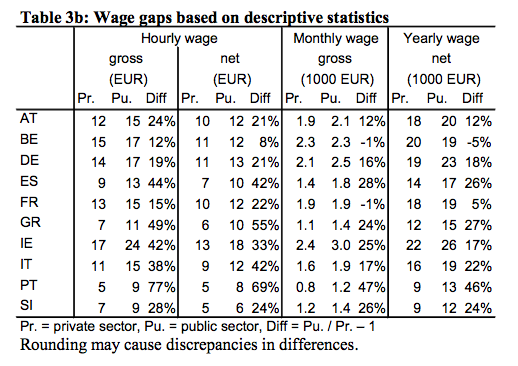
The
summary of the premium evolution is provided here:
In
the chart above, Ireland has the second highest gap after
Portugal.
The
paper provides a reminder of a number of studies that have examined the
public-private sector wage gap in Ireland:
The
ECB research provides controls for a number of variables that can theoretically
explain diferences in pay between public and private sector, such as education
as skills proxy and gender, earnings groupings by percentiles, and
firm size. All are found to retain statistically signifcant public sector
earnings premium in the case of Ireland.
The
study also looks at one specific category - Education. "On average workers in
“Education” earn much higher wages with respect to workers with similar
characteristics in the private sector relative to workers in the other
sub-sectors, while workers in the “Health” sector are less at advantage, and as
in the case of Germany even at disadvantage with respect to their private sector
counterparts. This finding is confirmed on the basis of a formal statistical
test..."
And
the premium holds when controlling for workers' own
education:
So
overall, the study finds that: "A large body of literature has analysed the
issue using micro-data on single countries. Most of these studies find a
differential in favour of public sector workers, even after taking into account
some observable individual characteristics. As in the
previous studies, our results, referring to the period 2004-2007, point to a
conditional pay differential in favour of the public sector that is generally
higher for women, for workers at the bottom of the wage distribution, in the
Education and the Public administration sectors rather than in the Health
sector. We also find notable differences across countries, with Greece, Ireland, Italy, Portugal
and Spain exhibiting higher public sector premia than other
countries. The differential generally decreases when considering
monthly wages as opposed to hourly wages and if we restrict our comparison to
large private firms."
There
goes one of those "We are not Greece" comparatives that the Irish Government is
so keen on. When it comes to pay premium in the public sector, we are in the
Club Med (PIIGS) group after all.
What
will it take for markets to be convinced of the long-term soundness of European
public finances? Governments across the Continent are tightening their belts,
some with real cuts to services and entitlements, most with growth-killing tax
hikes.
Then
there is the wage bill. Though austerity has put a brake on salary increases,
holiday bonuses and new hiring, a working paper published this month by the
European Central Bank suggests governments have a long way to go to trim
civil-service pay down to size.
Economists
at eight European central banks studied public- and private-sector wages in 10
euro-zone countries in the period 1995-2009. In Europe as elsewhere, government
workers are on average older, better-educated and more likely to have managerial
roles than workers at private firms.
Yet
even controlling for these factors, the authors find that government
employees are paid much more than their counterparts in the rest of the
economy—40%-70% more in net hourly wages in Greece, Italy, Portugal and Spain,
and a third more in Ireland. The gap is 20%-25% in Austria,
France, Germany and Slovenia. Belgium is a surprising outlier: In net hourly
wages, Belgian civil servants take home only 8% more than other workers and come
out slightly behind in yearly wages.
It's
difficult to compare these figures directly with ones for other developed
countries owing to differences in methodology and data, but signs suggest that
the pay differential on the Continent is particularly high. In the U.K., the public-private gap
in hourly wages is only 7.5% after controlling for education, age and
qualification, according to research by the
London-based
Institute for Fiscal Studies. The
authors of the ECB paper cite studies that suggest that the
U.S.
gap was 10%-15% during the 1970s but fell during the
1980s.
What
accounts for the Continent's wide public-private pay differential? It's not as
if European governments are employing fewer people, thereby justifying higher
pay. Among the 10
countries in the ECB sample, government share of the labor force ranges from 19%
in Germany to 38% in Belgium. In the U.S. government workers are 17% of nonfarm
payrolls.
A
better explanation is the power of government-employee unions and
special-interest groups in Europe. In countries where data are available, union
membership is twice as high among government workers than in the rest of the
labor force. Then
there is the entrenched character of government employment in Europe.
In many countries on
the Continent, civil servants enjoy total job security and a fixed schedule of
salary increases. Pay for civil servants also tends to be insulated from trends
in the private labor market.
Despite
all this, the public-private wage gap in Europe wasn't always so
large, and really began to widen after 1999.
That has at least
something to do with the introduction of the euro, which allowed employees to
compare their pay with peers in other countries. One result was that government
workers in particular were able to negotiate better
contracts. The currency union also reduced government
borrowing costs, but it failed to bring about reforms to contain public-sector
creep.
Recent
pay cuts for government employees have provoked rioting and protests in southern
Europe and the U.K. this year. That's one unhappy by-product of
large welfare states. They create powerful interest groups that make it hard to
take goodies back once they are given out. But the alternative is many more long
years of widespread doubt that Europe can borrow or grow its way back to
solvency.
Printed
in The Wall Street Journal, page 14
By
Richard W. Rahn
-
The
Washington Times
Monday,
December 26, 2011
Even
though some are predicting the end of the world in 2012, there is a possibility
it could turn out better than 2011 (a low bar). Many people who are not part of
the political class continue to advance civilization and make things better for
us - like the late Steve Jobs.
Dr.
Ito Briones, who is a biochemist research scientist, a medical doctor and
something of a Renaissance man, recently wrote to me that he thinks the greatest
discovery in medical science was the creation of iPS (induced pluripotent stem
cells, or stem cells from reprogrammed skin cells) by Drs. Shinya Yamanaka and
Kazutoshi Takahashi. According to Dr. Briones, "Even though the clinical
application of iPS cells remains untested, the theories about aging and stem
cells and the fountain of youth principles are groundbreaking and extremely
fascinating. IPS science continues to move very fast. ... The promise for cures
to cancer and other diseases appears plausible now with iPS science. What this
discovery has also done is to open scientists' minds to the concept that nothing
is indeed impossible in biology."
Other
potential good news is that not all members of the political class are
unprincipled, self-serving, ignorant and shortsighted. We are seeing a growing
band of smart, responsible and knowledgeable people being elected to Congress
and other political bodies. One example is Rep. Paul Ryan, Wisconsin Republican,
who is chairman of the House Budget Committee. Mr. Ryan, a fine economist, put
together an economically sound and politically realistic budget that passed the
House of Representatives but, not unexpectedly, died in the Democrat-controlled
Senate. There is a real possibility that a sufficient number of the American
people will be rational enough to elect new members to the House and Senate (and
the presidency) to pass a Ryan-type budget before the United States goes off the
fiscal cliff, like Greece.
In
democratic countries, many politicians get themselves elected by making promises
for spending programs that the citizens cannot or are unwilling to pay
for. The
result is persistent deficit spending that ultimately spirals out of control.
The good news is that some democratic countries have learned how to avoid the
spending/deficit trap, and those countries can serve as examples for the less
prudent majority. (See accompanying chart.)
The
best example is Switzerland. The Swiss have managed to be fiscally responsible
for many decades, in part because they have a highly decentralized, direct
democracy. Most governmental functions take place at the local level rather than
the federal level in Switzerland, and as a result, the local governments must
compete with each other on taxes, regulations, etc., which tends to hold down
the growth in government and promotes liberty. Where government is close to the
people, and where the democratic process is direct, the people can more directly
hold elected officials responsible for misspending and
mismanagement.
The
United States was designed by its founders to have a small and relatively weak
central government, in which most of the government functions and power were
supposed to be at the state and local level.
The 10th Amendment to
the U.S. Constitution is very explicit: "The powers not
delegated to the United States by the Constitution nor prohibited by it to the
States, are reserved to the States respectively or to the people." The potential
good news is that as a result of the presidential debates, more people are
becoming aware of the 10th Amendment and are beginning to understand that if
Congress and the courts stopped ignoring this amendment, the U.S. likely would
have a smaller, more effective and more fiscally sound
government.
Sweden
and Canada provide role models for how highly developed democracies that have
created unsustainable welfare states can find peaceful and constructive ways out
of the dilemma. In
the mid-1990s, both countries were stagnating and headed toward a Greek-style
credit default because of the drag of bloated government spending, taxing and
regulation. In both
countries, the parties of the left and right came together to reverse course by
reducing tax rates, spending and destructive regulation and privatizing much of
what had been nationalized. Real growth has been revived in both Canada and
Sweden, and they both have very manageable debt-to-gross-domestic-product
ratios. Because Sweden is a small, homogenous country, it is
able to maintain a larger government as a percentage of GDP and still obtain
normal rates of economic growth than can more heterogeneous countries like the
U.S. and Switzerland.
The
good news is that it is well-known what economic reforms are necessary to revive
growth and fiscal sanity in the major European countries and
America. But
it also takes leaders who can explain what needs to be done and persuade the
people to endure the pain of the necessary transitional hardship in the way
British Prime Minister Margaret Thatcher and President Reagan
did.
As a
reality check on the potential good news, my friend Jim Stewart, a neurologist,
asked: "While the medical community is indeed making great strides in extending
our lives, who ... wants to live longer if the politicians keep making things
worse?"
Richard
W. Rahn is a senior fellow at the Cato Institute and chairman of the Institute
for Global Economic Growth.
2011-12-23
13:28:19
http://www.ocregister.com/common/printer/view.php?db=ocregister&id=332895
Our
lesson for today comes from the Gospel according to Luke. No, no, not the
manger, the shepherds, the wise men, any of that stuff, but the other
birth:
"But
the angel said unto him, Fear not, Zacharias: for thy prayer is heard; and thy
wife Elisabeth shall bear thee a son, and thou shalt call his name
John."
That
bit of the Christmas story doesn't get a lot of attention, but it's in there –
Luke 1:13, part of what he'd have called the back story, if he'd been a
Hollywood screenwriter rather than a physician. Of the four gospels, only two
bother with the tale of Christ's birth, and only Luke begins with the tale of
two pregnancies. Zacharias is surprised by his impending paternity – "for I am
an old man and my wife well stricken in years." Nonetheless, an aged, barren
woman conceives and, in the sixth month of Elisabeth's pregnancy, the angel
visits her cousin Mary and tells her that she, too, will conceive. If you read
Luke, the virgin birth seems a logical extension of the earlier miracle – the
pregnancy of an elderly lady. The physician-author had no difficulty accepting
both. For Matthew, Jesus' birth is the miracle; Luke leaves you with the
impression that all birth – all life – is to a degree miraculous and
God-given.
POLITICAL
CARTOONS:
75
cartoons and photos of Korean leader Kim Jong-Ill and
sons
We now
live in Elisabeth's world – not just because technology has caught up with the
deity and enabled women in their fifties and sixties to become mothers, but in a
more basic sense. The problem with the advanced West is not that it's broke but
that it's old and barren. Which explains why it's broke. Take Greece, which has
now become the most convenient shorthand for sovereign insolvency – "America's
heading for the same fate as Greece if we don't change course," etc. So Greece
has a spending problem, a revenue problem, something along those lines, right?
At a superficial level, yes. But the underlying issue is more primal: It has one
of the lowest fertility rates on the planet. In Greece, 100 grandparents have 42
grandchildren – i.e., the family tree is upside down. In a social democratic
state where workers in "hazardous" professions (such as, er, hairdressing)
retire at 50, there aren't enough young people around to pay for your
three-decade retirement. And there are unlikely ever to be
again.
Look
at it another way: Banks are a mechanism by which old people with capital lend
to young people with energy and ideas. The Western world has now inverted the
concept. If 100 geezers run up a bazillion dollars' worth of debt, is it likely
that 42 youngsters will ever be able to pay it off? As Angela Merkel pointed out
in 2009, for Germany an Obama-sized stimulus was out of the question simply
because its foreign creditors know there are not enough young Germans around
ever to repay it. The
Continent's economic "powerhouse" has the highest proportion of childless women
in Europe: one in three fräulein have checked out of the motherhood
business entirely. "Germany's working-age population is likely to decrease 30
percent over the next few decades," says Steffen Kröhnert of the Berlin
Institute for Population Development. "Rural areas will see a massive population
decline, and some villages will simply
disappear."
If the
problem with socialism is, as Mrs. Thatcher says, that eventually you run out of
other people's money, much of the West has advanced to the next stage: it's run
out of other people, period. Greece is a land of ever-fewer customers and fewer
workers but ever more retirees and more government. How do you grow your economy
in an ever-shrinking market? The developed world, like Elisabeth, is barren.
Collectively barren, I hasten to add. Individually, it's made up of millions of
fertile women, who voluntarily opt for no children at all or one designer kid at
39. In Italy, the home
of the Church, the birthrate's somewhere around 1.2, 1.3 children per couple –
or about half "replacement rate." Japan, Germany and Russia are already in net
population decline. Fifty percent of Japanese women born in the Seventies are
childless. Between 1990 and 2000, the percentage of Spanish women childless at
the age of 30 almost doubled, from just over 30 percent to just shy of 60
percent. In Sweden, Finland, Austria, Switzerland, the Netherlands and the
United Kingdom, 20 percent of 40-year old women are childless. In a recent poll,
invited to state the "ideal" number of children, 16.6 percent of Germans
answered "None." We are living in Zacharias and Elisabeth's world – by
choice.
America
is not in as perilous a situation as Europe – yet. But its rendezvous with
fiscal apocalypse also has demographic roots: The baby boomers did not have
enough children to maintain the solvency of mid-20th century welfare systems
premised on mid-20th century birthrates. The "Me Decade" turned into a Me
Quarter-Century, and beyond. The "me"s are all getting a bit long in the tooth,
but they never figured there might come a time when they'd need a few more
"thems" still paying into the treasury.
The
notion of life as a self-growth experience is more radical than it
sounds. For most of
human history, functioning societies have honored the long run: It's why
millions of people have children, build houses, plant trees, start businesses,
make wills, put up beautiful churches in ordinary villages, fight and, if
necessary, die for your country. A nation, a society, a community is a compact
between past, present and future, in which the citizens, in Tom Wolfe's words at
the dawn of the "Me Decade," "conceive of themselves, however unconsciously, as
part of a great biological stream."
Much
of the developed world climbed out of the stream. You don't need to make
material sacrifices: The state takes care of all that. You don't need to have
children. And you certainly don't need to die for king and country. But a
society that has nothing to die for has nothing to live for: It's no longer a
stream, but a stagnant pool.
If you
believe in God, the utilitarian argument for religion will seem insufficient and
reductive: "These are useful narratives we tell ourselves," as I once heard a
wimpy Congregational pastor explain her position on the Bible. But, if
Christianity is merely a "useful" story, it's a perfectly constructed one,
beginning with the decision to establish Christ's divinity in the miracle of His
birth. The hyper-rationalists ought at least to be able to understand that
post-Christian "rationalism" has delivered much of Christendom to an utterly
irrational business model: a pyramid scheme built on an upside-down pyramid.
Luke, a man of faith and a man of science, could have seen where that leads.
Like the song says, Merry Christmas, baby.
©MARK
STEYN
Timothy Taylor has a must-read post.
(I could say that almost every day, but today I am going to provide additional
commentary.) It's long, but here is a brief excerpt.
In fact,
Megan McArdle reminds us that we tax
the poor at high marginal rates by phasing out benefits at low levels of
income.
http://conversableeconomist.blogspot.com/2011/12/government-redistribution-international.html
Income
inequality has been growing in most high-income countries around the
world.
How much do the redistribution policies of government hold down this growth in
inequality? The OECD has published Divided
We Stand: Why Inequality Keeps Rising. (The report can be read for free
on-line with a slightly clunky browser, and a PDF of an "Overview" chapter can
be downloaded.) Chapter 7 of the report discusses "Changes in Redistribution in
OECD Countries Over Two Decades," which basically means from the mid-1980s to
the mid-2000s. The chapter draws on a longer background paper that is freely
available on-line: Herwig Immervoll and Linda Richardson's paper, "Redistribution
Policy and Inequality Reduction in OECD Countries: What Has Changed in Two
Decades?"
The United States does relatively
little redistribution in comparison with other OECD countries.
This graph from the "Overview" of the OECD report compares the inequality of
market incomes to the inequality of disposable income after taxes and benefit
payments. Inequality is
measured by a Gini coefficient. For a more detailed explanation of how this is
measured, see my November 1 post on Lorenz curves and Gini
coefficients. But as a quick overview, it suffices
to know that a Gini coefficient measures inequality on a scale from zero to 1,
where zero is perfect equality where everyone has exactly the same income and 1
is perfect inequality where one person has all the income. The
United States has one of the most unequal distributions of market income and of
disposable income, and in this comparison group, U.S. policy does relatively
little to reduce the disparity. The OECD writes: "Public cash
transfers, as well as income taxes and social security contributions, played a
major role in all OECD countries in reducing market-income inequality. Together,
they
were estimated to reduce inequality
among the working-age population (measured by the Gini coefficient) by an
average of about one-quarter across OECD countries. This redistributive effect
was larger in the Nordic countries, Belgium and Germany, but well below average
in Chile, Iceland, Korea, Switzerland and the United States (Figure
9).
Any
economy that has a progressive tax code and benefits for those with low incomes
will find that as inequality increases, redistribution will also increase
automatically as a result of these preexisting policies Some countries may also
take additional steps, when faced with rising inequality of market incomes, to
raise the amount of redistribution. A table in Ch. 7 of the OECD report
calculates how much of the increase in increase in market incomes from the
mid-1980s to the mid-2000s was offset by a rise in
redistribution.
Denmark is the extreme case:
increased redistribution from the mid-1980s to the mid-2000s offset more than
100% of the rise in inequality of market incomes. In a number of countries, the
rise in redistribution offset from 35-55% of the rise in inequality of market
incomes over this time period: Australia, Canada, West Germany, Netherlands,
Norway, Sweden. By comparison, in the U.S. the rise in government redistribution
from the mid-1980s to the mid-2000s offset just 9% of the rise in market
inequality.
It's useful to look at redistribution
policies both from the tax side and the benefits side. The striking theme that
emerges is that in most countries, benefits for those with low incomes
are much more important in reducing inequality than are progressive tax
rates.
On the tax side, the U.S. tax code is already
highly progressive compared with these other countries. The OECD published at
2008 report called "Growing Unequal: Income Distribution and Poverty in OECD
Countries, which states (pp. 104-106): "Taxation is most progressively
distributed in the United States, probably reflecting the greater role played
there by refundable tax credits, such as the Earned Income Tax Credit and the
Child Tax Credit. ... Based on the concentration coefficient of household taxes,
the United States has the most progressive tax system and collects the largest
share of taxes from the richest 10% of the population. However, the richest
decile in the United States has one of the highest shares of market income of
any OECD country.After standardising for this underlying inequality ...
Australia and the United States collect the most tax from people in the top
decile relative to the share of market income that they
earn."
This
finding is surprising to a lot of Americans, who have a sort of instinctive
feeling that Europeans must be taxing the rich far more heavily. But remember
that European countries rely much more on value-added taxes (a sort of national
sales tax collected from producers) and on high energy taxes. They also often
have very high payroll taxes to finance retirement programs. These kinds of
taxes place a heavier burden on those with lower
incomes.
In addition, top income tax rates all over the
world have come down in recent decades, and the U.S. top rate is near a fairly
common level. From the "Overview: "Top rates of personal income tax, which were
in the order of 60-70% in major OECD countries, fell to around 40% on average by
the late 2000s." From the
Immervoll and Richardson working
paper: "Reductions in top [personal income tax] rates were steepest in Japan
(from 70 to 37 percent), Italy (65 to 43), United Kingdom (60 to 40), and France
(65 to 48). The flattening of schedules mostly concerned higher income ranges
(Australia, Austria, Finland, France, Germany, Japan, United Kingdom, United
States)."
The real difference in how much
redistribution affects inequality arises from differences in
benefits. The OECD writes: "Benefits had a much stronger
impact on inequality than the other main instruments of cash distribution --
social contributions or taxes. ... The most important benefit-related
determining factor in overall distribution, however, was not benefit levels but
the number of people entitled to transfers." This theme applies
to a number of benefit programs, including disability payments. But here is an
illustrations with regard to unemployment insurance, taken from the Immervoll
and Richardson working paper. They write: "Figure 11 indicates that the shares
of unemployed reporting benefit receipt have dropped in a majority (two thirds)
of the countries shown, while only a few recorded significant increases."
Notice that the share
of the unemployed in the U.S. who get unemployment benefits is on the low end of
the spectrum.
This
pattern also fits with my post on November 1 about a Congressional Budget Office
report which found that Federal Redistribution is
Dropping. It pointed out that the share of
federal redistribution spending programs going to the elderly has been steadily
rising, while the share going to the non-elderly poor and near-poor has not been
rising. The working paper also notes: "[O]ver time, almost all
countries devoted declining shares of total spending to cash benefits that
mostly benefit children and working-age individuals."
The OECD report
been criticized for suggesting that higher taxes on those with the very highest
incomes might be worth considering, but this is certainly not the main focus of
the report. Indeed, given that the U.S. tax system is
already one of the most progressive, this recommendation seems aimed more at
other countries than at the United States. The "Overview" of the
OECD report states: "However, redistribution strategies based on government
transfers and taxes alone would be neither effective nor financially
sustainable. First, there may be counterproductive
disincentive effects if benefit and tax reforms are not well designed.
Second, most OECD countries currently operate under a reduced fiscal
space which exerts strong pressure to curb public social spending and raise
taxes. Growing employment may contribute to sustainable cuts in
income inequality, provided the employment gains occur in jobs that offer career
prospects. Policies for more and better jobs are more important than ever." In
particular, the OECD report emphasizes as policy tools to fight unemployment
job-related training and education, continuing education over the work life, and
reforming rules prevalent in many countries that separate the workforce into
temporary and permanent employment contracts.
As part of an overall plan
to get the budget deficit under control, and given the rise in inequality over
recent decades, I would
be favor a somewhat higher marginal tax rate on those with very high income
levels. But it seems to me that U.S. political discourse has
focuses way too much on taxing the rich. Hard-core Democrats and Republicans
both like the familiar arguments over taxes: it gets their blood pumping and
their base motivated. But U.S. political discourse has far
too little about reforming labor markets to open up more jobs, or about how to
stimulate job-related education for life. And neither party
stands up for raising government spending in ways that would affect those with
lower income levels more, whether through income payments to families
(especially to the working poor) or through spending on public goods like
neighborhood safety (police, lighting and activities), parks and libraries, or
education and public health that would have a greater effect on the quality of
life for those with lower incomes.
See
graphs at http://oi39.tinypic.com/1ar02.jpg
Europe
is lurching toward a more perfect fiscal union, or at least that's how the
Germans describe it. They call it Stabilitätsunion.
Market
doubts about Greece's ability to pay its debts have been contagious, spreading
to Ireland and Portugal, then to Italy and Spain.
Europe
is lurching toward a more perfect fiscal union, or at least that's how the
Germans describe it. They
call it Stabilitätsunion. David Wessel on The News Hub looks at what lessons
the American fiscal union hold for Europe. Photo: AP
The
only long-term fix that can save the euro, in the Germans' view, is to tighten
collective control over national finances to hard-wire fiscal
discipline.
The
U.S. has a fiscal union. Through Washington, money moves from taxpayers in
Connecticut to the unemployed in California with less uproar than money goes
from Germany to Greece. Workers move freely among the 50 U.S. states.
Differences in inflation rates among states don't persist as they do among
European countries. Nearly all U.S. states already are required, often by
their constitutions, to balance budgets annually (though that doesn't stop them
from making unfunded pension promises).
But as
in Europe, the states share a currency. Each borrows on its own without explicit
federal backing. And borrow they do: The U.S. municipal-bond market totals $2.9
trillion.
Which
leads to a question that economists have been pondering: If Greece could push up
Italy's borrowing costs, could intensifying market doubts about the
credit-worthiness of Illinois or Puerto Rico (which has more debt relative to
the size of its economy than any state) do the same for California? And what
lessons does the American fiscal union hold for Europe?
Enlarge
Image
The
answers are surprising. Consider this hypothetical: Illinois, already paying
higher interest rates than other states because of its debt load and
dysfunctional politics, runs into serious trouble paying its debts. Ratings
plunge; worries mount. What happens to the yield investors demand to lend to
Ohio?
Look
at Europe, and the answer seems clear: Trouble in one place with a lot of debt
pushes up borrowing rates for others with a lot of debt.
But
that isn't what has happened in the U.S., according to a new International
Monetary Fund working paper.
Examining the ups and downs of 10-year municipal debt from 2005 through early
2011, it finds that an increase in borrowing costs in one state generally
results in lower borrowing costs in
others, the opposite of the spillovers so evident in
Europe.
Why?
The economists—Rabah Arezki and Amadou Sy of the IMF and Bertrand Candelon of
Maastricht University—aren't sure. (Sigh.)
Perhaps the muni market is dominated by tax-exempt mutual funds; they don't flee
the market when one issuer looks shaky but move money to another. Or perhaps
troubles don't quickly cross state lines because even with scary headlines,
individual investors stick with home-state bonds thanks to the tax benefits.
Some
muni bond veterans scoff at this ivory tower number-crunching and the attempts
to use the recent past to predict the future.
"Most
muni investors operate on the assumption that the default risk is very low,"
says Matt Fabian of Municipal Market Advisers. "If you were to introduce
critical default risk for, say, Illinois, that would be a real chink in the
armor."
But
Columbia University's Andrew Ang, whose work parallels that of the IMF
team, sees an intriguing lesson for Europe. The 50 U.S. states are far more
integrated economically than the 17 euro-zone economies, he observes. So one
would expect (and, indeed, many economists have) that U.S. state bonds would
respond more to winds buffeting the whole U.S. economy—say, higher oil prices or
falling inflation or a rating downgrade of the nation's credit—while national
bonds in the less integrated European economy would respond more to individual
country conditions.
The
opposite is true, according to Mr. Ang and Francis Longstaff of the
University of California, Los Angeles, who looked at credit-default swaps,
insurance that investors can buy against default, from 2008 through early
2011.
They
calculate that common factors, or systemic risk, account for 31% of the credit
risk of European sovereigns, but only 12% of the credit risk of U.S. state
bonds.
"If
Illinois goes bust, it is likely Illinois will go bust alone," says Mr. Ang. "If
Greece goes bust, it's likely Greece will go bust along with other European
countries. Many people's economic intuition is just the
opposite."
Why
are the two so different? Mr. Ang offers two competing
hypotheses. (Sigh.) No matter how bad California's debt mess, perhaps no one
fears the dollar-union will disintegrate. Or maybe investors are certain
Washington would ride to the rescue of a failing state; not sure Germany would
do the same.
The
logical and perhaps counterintuitive conclusion: Even if Europe lashed national
economies together in American-style fiscal union, bond markets wouldn't view
the debt of the 17 counties as roughly equivalent (as they erroneously did
before the crisis). They would still distinguish between Greece and Germany,
just as they distinguish between Illinois (paying 3.7% on 10-year debt) and
Georgia (1.96%.)
Write
to David
Wessel at capital@wsj.com
Across
Europe and the United States, the fiscal crisis is setting up an epic battle
among government services, pensioners, government employees, creditors and
taxpayers.
There is simply not enough money coming in to pay all the promises politicians
have made. The shortfalls and fights are challenging our democracies and
shifting wealth from the private sector to ever bigger government.
The
hope has been that Europe's debt crisis would force government downsizing in
time to meet cash flow requirements. Newfound fiscal discipline would provide a
silver lining to the debt crisis. But that's not working out.
Germany's
insistence on centralized fiscal discipline for the euro zone will lead to a
massive expansion of bureaucracies in Brussels, Frankfurt and Berlin. They'll
include temporary and permanent bailout funds, dangerously intrusive powers for
the International Monetary Fund and the European Central Bank, endless summits,
new taxes on property, and recessions.
With
Europe's government structures assured of getting even bigger, the U.K. reacted
immediately by opting out. U.S. lawmakers are already
objecting to the
European plan to expand the IMF. As in Greece, IMF programs are antigrowth,
imposing austerity on the private economy, not the
government.
Greece has raised value-added and property taxes, then projected revenue
increases that never materialize in order to keep payments flowing to creditors
and the government's entourage.
Governments
on both sides of the Atlantic are trying to use the crisis to grow rather than
shrink. News
of Europe's fiscal incompetence abounds, but Washington had no budget at all in
2010 or 2011 and the federal deficit grew at record pace. President Obama sailed
through 2011 without any significant spending cuts or government downsizing.
With
year-end approaching, the federal budget horizon has contracted to two weeks.
Common practice is for Congress and the president to spend as much as possible
in December and then adjourn, hoping voters will forget about it after New
Year's Eve.
Enlarge
Image
Corbis
Financial
markets are so sensitive to the $3.6 trillion in annual federal spending that
they would likely see huge gains if Congress simply adjourned without the normal
year-end blow out. Even better would be for the president to call a January
cabinet meeting with the purpose of cutting spending and regulation to encourage
private job growth.
In
February, President Obama will be able to impose another $1.2 trillion
debt-limit increase using special voting rules forced through Congress last
August to avoid a government shutdown. It
should be clear by now that politicians will not voluntarily reduce government
or government debt. The so-called debt limit is harmful because it threatens
default and broad government shutdowns, both unacceptable, but doesn't limit
spending at all.
The
debt limit should be replaced with a new debt ceiling that forces Washington to
cut spending. When the debt-to-GDP ratio is above target, Washington should
suffer escalating penalties on its power, benefits and spending
authority.
There should be no
threat of debt default or government shutdown. Instead, Washington should
face a benefits straitjacket that is so uncomfortable for the president, his
senior executives and Congress that they work around the clock to enact spending
cuts and asset sales to bring debt back below target. They
should get a bonus if they get the job done and embarrassing, escalating
penalties if they don't.
Here
are some possible penalties: 1% pay cut per month for the 10,000
highest-paid government employees with a prohibition on it being restored;
suspension of limousines for assistant secretaries and higher; market-rate
monthly fee for free government parking. During periods of
excess debt, the president should have impoundment authority but also be
required to write a monthly letter to Congress stating preferred spending cuts
equal to 20% of the fiscal deficit.
Grappling
with out-of-control government spending in southern Europe, Germany is seeking automatic
penalties when fiscal deficits are too large. The problem is that governments
will probably write the penalties so they hit taxpayers and the private sector.
It's unlikely European governments will write penalties aimed at
themselves. There's already talk of the bloated
Italian government taxing the property of the Catholic Church to avoid spending
cuts and asset sales.
Across
the U.S. and Europe, big government is winning the crisis game, adding taxes,
regulatory power and whole new institutions. Voters want restraint, but there's
no mechanism to control government spending, so debt-to-GDP ratios go up rather
than down.
Even
at the state and local level, which is supposed to be closer to the people,
governments find ways to grow. In
an age-old government shell game, tax increases are projected to cause big
revenue gains, which governments rush to spend. When actual revenues fall short,
the government blames the economy, borrows the shortfall, and proposes new
taxes, creating a debt cycle.
This
budgeting trick is replayed year after year around the nation. New York state
demonstrated this last week with Gov. Andrew Cuomo's $2 billion increase in
annual income taxes to "balance the budget." The increase in projected tax
revenues will allow a major increase in state spending in 2012. And despite
balanced budget requirements, New York state and local debt has surged above
$300 billion.
One of
the few hopeful signs in the two-continent budget mess is that a few U.S. states
and localities are experimenting with different political responses, some of
which will promote growth. Wisconsin's government stopped collecting
union dues, changing the balance of political power. Heavily Democratic Rhode
Island passed a law allowing a hybrid 401(k) pension system, a key
structural reform that would transform the nation's fiscal outlook if widely
adopted.
The
fiscal questions facing Europe and the U.S. are central to our democracies. Can
politicians be incentivized or penalized enough to lead a downsizing of
government? Which unaffordable contracts and promises should be reduced? How
fast will the outlays grow for lifetime pensions and retiree health care?
To win
elections, politicians have promised practically endless government spending and
covered up the cost, leaving generations of taxpayers obligated to pay off the
debt. That's wrong, but neither the U.S. nor Europe has a plan to stop it. A
first step would be to
use more effective debt and deficit limits to force governments to spend less
and end to the debt cycle.
Mr.
Malpass, a deputy assistant Treasury secretary in the Reagan administration, is
president of Encima Global LLC.
This Web Page Created with PageBreeze Free HTML Editor